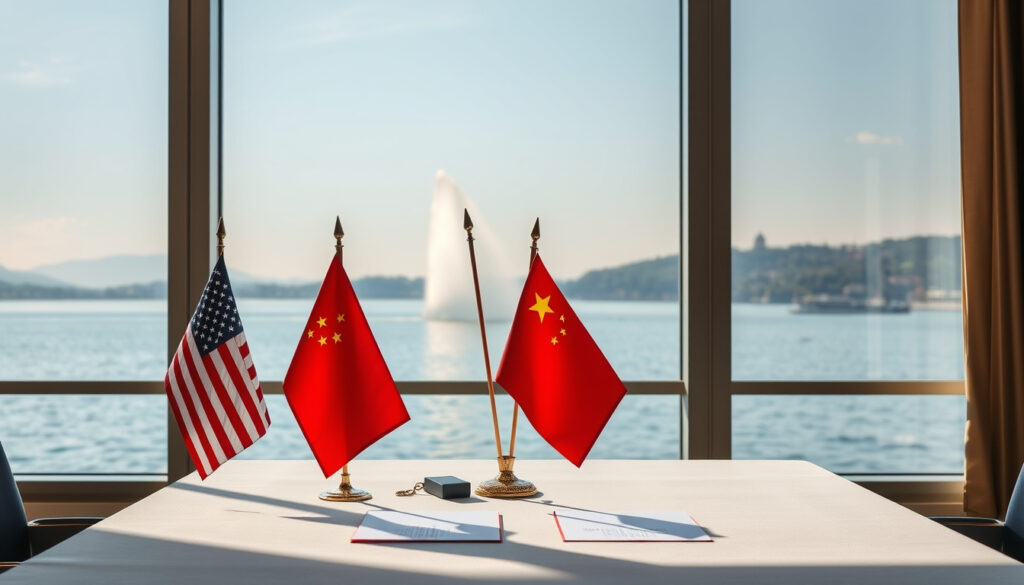
US-China Trade Talks: Geneva Outcome & Impact
Trade wars rarely end with a handshake and a single document, but the May 2025 Geneva meeting between the U.S. and China came close after months of escalating tariffs that pushed rates past 140% on some goods, with both sides agreeing to a 90-day pause on new duties and a framework for continued talks. What follows is a look at what actually happened in Geneva, who holds the leverage, and what the next moves could mean for businesses and consumers.
U.S. goods imports from China (2021): $506 billion ·
China’s trade surplus with the U.S. (2024): $361 billion ·
U.S. goods exports to China (2021): $151 billion ·
China’s largest trade partner: ASEAN (2024)
Quick snapshot
- Geneva joint statement signed May 12, 2025 (The White House)
- US agreed to suspend 24 percentage points of additional ad valorem duty for 90 days (The White House) (The White House)
- China agreed to suspend 24 percentage points of additional duties for 90 days (The White House) (The White House)
- May 12, 2025 – Joint statement on tariff modifications (The White House)
- June 11, 2025 – Framework agreed to revive trade deal (Reuters)
- July 2025 – 90-day pause due to expire; no new tariffs imposed (Reuters)
- Further talks on rare-earth access and student visas (Reuters)
- Potential permanent tariff reset if mechanisms hold
Four years of tit-for-tat tariffs have reshaped the numbers that matter most. Here’s a snapshot of the trade relationship before and after the Geneva reset.
| Metric | Value | Source |
|---|---|---|
| 2025 trade talk location | Geneva, Switzerland (May 12, 2025) | The White House |
| US tariff rate before 2025 | up to 25% on Chinese goods | Reuters |
| China’s biggest export customer | ASEAN (2024) | Reuters |
| US debt held by China | approximately $820 billion | Reuters |
| US effective tariff rate after June 2025 agreement | 55% total (10% baseline + 20% fentanyl + 25% existing) | Reuters |
| China’s effective tariff rate after June 2025 agreement | 10% on US goods | Reuters |
| China’s trade surplus with US (2024) | $361 billion | US Census Bureau |
| US goods imports from China (2021) | $506 billion | US Census Bureau |
The pattern: a handful of numbers reveal two economies still deeply linked, but with China leaning more on ASEAN and the US carrying a widening deficit.
What was the outcome of the 2025 US-China trade talks?
US tariff adjustments announced in May 2025
- The U.S. agreed to suspend 24 percentage points of its additional ad valorem duty on Chinese goods for an initial 90-day period while retaining a 10% rate (The White House).
- China mirrored the move, suspending 24 percentage points of its additional ad valorem duty on U.S. goods for the same period (The White House).
- Neither side publicly addressed the pre-existing 145% U.S. tariff or China’s 125% tariff in the wrap-up comments (Reuters).
China’s commitments on intellectual property
- The Geneva statement included a mechanism to continue discussions on economic and trade relations (The White House).
- By June 11, 2025, a framework was established to revive the trade agreement and eliminate China’s restrictions on rare-earth exports (Reuters).
- China also pledged to facilitate access for Chinese students to U.S. universities (Reuters).
U.S. importers and Chinese exporters both got a 90-day window to adjust. The real question is whether the pause becomes permanent or just a prelude to the next escalation.
The pause in tariffs may not resolve the structural issues, but it provides a breathing space for both economies.
Who is China’s largest trade partner and how does it affect the US?
ASEAN as China’s top trading bloc
- ASEAN became China’s largest trade partner in 2024, surpassing the United States (Reuters).
- China’s exports to ASEAN grew faster than to any other region, reflecting deliberate supply-chain diversification (Council on Foreign Relations).
US share of China’s trade
- The U.S. now accounts for less than 15% of China’s exports (US Census Bureau).
- Despite this decline, the U.S. remains the single largest destination for Chinese goods by value (Reuters).
What this means: China has reduced its reliance on the U.S. market, but not eliminated it. For American companies, the shift to ASEAN means longer supply chains and new compliance costs.
Can China survive without the US?
China’s record trade surplus
- China’s trade surplus with the U.S. hit a record $361 billion in 2024 (US Census Bureau).
- Overall, China’s global trade surplus reached an all-time high in 2024, driven by exports of electronics, machinery, and green energy products (Reuters).
Potential impact of US decoupling
- Analysts at the Council on Foreign Relations argue China could absorb the shock of losing U.S. access in the medium term by selling more to emerging markets.
- However, the loss of U.S. demand for high-value consumer electronics and machinery would hit China’s most profitable export sectors hard (Reuters).
China’s record surplus masks a vulnerability: its most sophisticated industries depend on American innovation and intermediate goods. Cut that dependency, and the surplus could shrink fast.
China’s ability to weather a full decoupling remains questionable, given its dependence on US technology and markets.
What country is the US most dependent on for trade?
US import reliance on China
- China is the largest source of U.S. imports, supplying roughly $506 billion in goods as of 2021 (US Census Bureau).
- Key categories include consumer electronics, appliances, and textiles — sectors where China commands 50% or more of global production capacity (Council on Foreign Relations).
Alternative sourcing from Mexico, Canada
- Mexico and Canada together supply about 25% of U.S. imports, mostly in vehicles, energy, and agricultural products (US Census Bureau).
- While nearshoring has accelerated, neither Mexico nor Canada can replace China’s capacity in electronics assembly and rare-earth processing in the short term (Reuters).
The trade-off: The U.S. can source more from allies, but at a higher cost and with a longer ramp-up. For now, China remains the least expensive source for core consumer goods.
Does China owe any debt to the USA?
Chinese holdings of US Treasury securities
- China holds approximately $820 billion in U.S. Treasury bonds (Reuters).
- This makes China one of the largest foreign creditors to the United States, after Japan (Council on Foreign Relations).
Implications for the trade relationship
- During trade disputes, Beijing has sometimes reduced its Treasury holdings as a signal of displeasure (Council on Foreign Relations).
- However, a full sell-off would hurt China’s own asset value and currency stability, so it remains a rarely used lever (Reuters).
Why this matters: China’s Treasury holdings give it a seat at the table, but they also tie its hands. Any move to weaponize the debt would cut both ways.
Timeline: key moments in US-China trade relations
- 1979 – U.S.-China trade agreement normalizing trade relations signed.
- 2001 – China joins the WTO, trade volumes surge.
- 2018 – US imposes tariffs; China retaliates; trade war begins.
- January 2020 – Phase One trade deal signed.
- May 12, 2025 – Geneva talks produce joint statement on tariff adjustments (The White House).
- June 11, 2025 – Framework agreed to revive trade deal, including rare-earth export commitment (Reuters).
- July 2025 – 90-day pause expires; no new tariffs imposed (Reuters).
The timeline highlights the cyclical nature of US-China trade tensions, where agreements are followed by new disputes.
What’s confirmed — and what’s still unclear
Confirmed facts
- Geneva meeting occurred May 12, 2025, with both sides releasing a joint statement (The White House).
- US and China each suspended 24 percentage points of additional ad valorem duties for 90 days (The White House).
- ASEAN became China’s largest trade partner in 2024 (Reuters).
- China holds over $800 billion in US Treasury securities (Reuters).
- US effective tariff on Chinese goods after June 2025 agreement: 55% (Reuters).
What’s still unclear
- Whether the 90-day pause will lead to a permanent tariff reduction (Reuters).
- Full impact of tariff adjustments on US consumer prices (no comprehensive analysis yet).
- Whether China will fully deliver on rare-earth export commitments — Washington said deliveries were slower than agreed (Reuters).
- Long-term effect on supply chain diversification away from China.
- The speed of China’s rare-earth export commitment implementation remains uncertain (Reuters).
These uncertainties underscore the fragility of the current truce.
Voices from the talks
“The United States and China held a productive economic and trade meeting in Geneva on May 12, 2025. Both sides reaffirmed their commitment to reach a long-term agreement that addresses the bilateral trade imbalance and promotes economic growth.”
– The White House (joint statement summary)
“The US-China trade war has reshaped global supply chains more in five years than the previous 20 years of trade liberalization. The Geneva pause buys time, but the structural decoupling is already underway.”
– Council on Foreign Relations (background analysis)
The divergent interpretations from official and analytical sources show the gap between diplomatic language and economic reality.
What it means for businesses and consumers
The Geneva talks and subsequent framework have given both sides room to maneuver, but the underlying tensions remain. U.S. tariffs on Chinese goods are still at 55% — far above pre-2018 levels — and China’s countermeasure sits at 10%. Supply chain diversification has accelerated, yet the U.S. still imports half a trillion dollars from China annually. For American consumers, the immediate impact is a pause in further price increases on electronics and appliances. For Chinese manufacturers, the window to renegotiate terms is open — but only for 90 days. For investors, the AI stocks to buy 2026 analysis shows that tariff-sensitive tech sectors remain volatile. Meanwhile, currency markets have reacted to every twist — check the latest 1500 yen to USD rate to see how the dollar-yen pair has moved on trade headlines. The pattern is clear: neither side can afford a complete break, but neither trusts the other enough to fully re-engage. For the US Treasury, the choice is between accepting persistent deficits or forcing a painful reindustrialization. For China, the choice is between becoming a self-contained economy or maintaining export-led growth through new partners like ASEAN. The consequence for both: a fragmented global trade system where negotiation and confrontation run in parallel.
youtube.com, evergreenresources.com, reuters.com, mofo.com, reuters.com, youtube.com, whitehouse.gov, traxtech.com, uscc.gov
Frequently asked questions
What was the purpose of the 2025 US-China trade talks?
The May 2025 Geneva talks aimed to de-escalate the trade war by agreeing on reciprocal tariff modifications and establishing a mechanism for ongoing discussions (The White House).
Who participated in the Geneva trade talks?
U.S. and Chinese trade officials, including representatives from the Office of the United States Trade Representative and China’s Ministry of Commerce, held the meeting in Geneva (Reuters).
What specific tariffs did the US agree to modify?
The U.S. agreed to suspend 24 percentage points of its additional ad valorem duty on Chinese goods for 90 days, retaining a 10% baseline rate (The White House).
How does China’s trade surplus affect the negotiations?
China’s record $361 billion surplus with the U.S. gives it leverage — American consumers depend on Chinese goods — but also makes it a target for tariff hikes aimed at rebalancing (US Census Bureau).
What is the current status of the US-China trade war?
As of July 2025, the 90-day tariff pause has expired but no new tariffs have been imposed. A framework for a broader agreement is in place, but the 55% US tariff and 10% Chinese tariff remain (Reuters).
Are US tariffs on Chinese goods still in place?
Yes. The US maintains a 55% effective tariff rate on Chinese goods (10% baseline, 20% fentanyl-related, 25% existing) (Reuters).
How do the trade talks affect prices in the US?
A pause in tariff escalation prevents further immediate price increases on consumer electronics and household goods, but the existing tariffs continue to add costs that are partially passed to consumers (Council on Foreign Relations).
What role does the WTO play in US-China trade disputes?
The WTO provides a dispute resolution mechanism, but both countries have bypassed it through unilateral tariffs. The Geneva framework does not directly involve the WTO (Council on Foreign Relations).
The trade relationship between the US and China remains the most consequential bilateral economic relationship in the world, with implications for global supply chains and consumer prices.
More related posts
 23 cm to Inches: Exact 9.055, Formula, Chart & Shoe Size
 AP College Football Rankings 2025-26: Latest Top 25 Poll Updates
 How to Cancel Audible Membership: Step-by-Step Guide (2025)
 Catching Fire: Answers to Top Questions
 The Incredible Hulk Cast: 2008 Film Actors and History
 Michigan vs Ohio State 2025: Player Stats & Game Recap
 Pictures of Breast Cancer Lumps: What They Look Like (Real Photos)
 Wicked for Good Tickets: 2025 Prices & Where to Buy