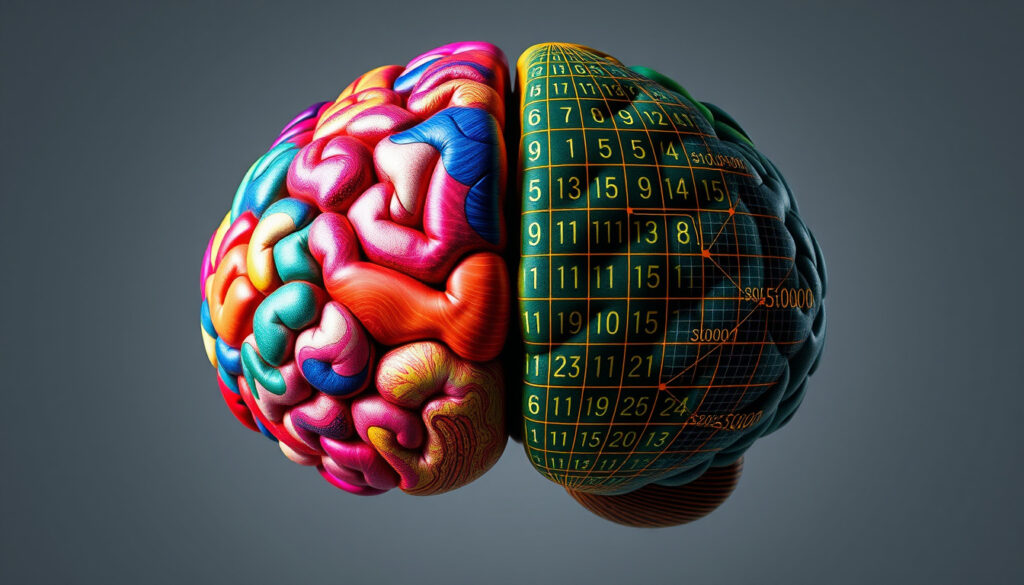
Right Brain vs Left Brain: Myth, Facts, and Personality Traits
You’ve probably taken an online quiz that told you whether you’re a creative “right-brain” person or a logical “left-brain” thinker. It’s a comforting idea — that your personality and talents can be traced to one side of your brain. But neuroscience tells a different story: the human brain doesn’t work that way, and the popular split has been debunked by decades of research. This article unpacks the real science of brain lateralization — what’s true, what’s myth, and what that means for how you understand yourself.
Belief in the myth: 91% (Dekker et al., 2013) ·
Nobel Prize year: 1981 ·
Brain hemispheres: 2 ·
Strongly lateralized functions: ~10% ·
Neurons in the brain: ~86 billion
Quick snapshot
- Origins in Roger Sperry’s split-brain experiments of the 1960s (Yale Scientific)
- Popular culture turned localized functions into personality labels (Yale Scientific)
- 91% of people still believe in the myth (University of Utah Health)
- Both hemispheres work together on nearly every cognitive task (PMC / NIH article)
- Only about 10% of brain functions are strongly lateralized (PMC / NIH article)
- No evidence for global “left-brained” or “right-brained” personality types (Science-Based Medicine)
- Language processing is typically left-dominant (McGill Office for Science and Society)
- Analytical and logical tasks often involve left-brain activity (PMC / NIH article)
- Basic math skills show more activation on the left side (Psychology Today)
- Spatial awareness and attention are more right-lateralized (Harvard Health Publishing)
- Emotional recognition involves right-brain circuits (Harvard Health Publishing)
- Creative thinking engages both hemispheres, not just the right (Harvard Health Publishing)
Five key facts about brain lateralization — one pattern: the science shows a connected brain, not a divided one.
| Label | Value |
|---|---|
| Origin of Myth | Roger Sperry’s split-brain research (1960s) |
| Belief Rate | 91% of people believe in the myth (Dekker et al., 2013, University of Utah Health) |
| Real Lateralization | Only about 10% of brain functions are strongly lateralized |
| Nobel Prize | Sperry won Nobel in 1981 for split-brain work |
| Key Fact | Both hemispheres constantly communicate via corpus callosum |
The implication: the myth persists despite overwhelming evidence against it, largely because it offers a simple story about who we are.
What is a right brain person like?
Common traits associated with right-brain dominance
- The right brain is popularly described as intuitive, creative, and emotional.
- These traits are not scientifically proven to be exclusive to the right hemisphere. A 2013 network-connectivity study published by PMC / NIH found that lateralization is a local property of brain networks, not a whole-brain trait.
- Both hemispheres work together for most cognitive tasks, as confirmed by NIH-hosted coverage on split-brain research.
How the right brain is linked to creativity and intuition
- Creativity involves both hemispheres. The right brain contributes to novel associations, but the left brain organizes and evaluates them.
- Emotional recognition does lean right, but the left hemisphere also processes emotional context.
- Harvard Health Publishing states that evidence discounting the left/right brain concept is accumulating.
What this means: calling someone a “right-brain person” is a convenient shorthand, but it doesn’t reflect how their brain actually works.
The most creative people aren’t “right-brain dominant” — they’re the ones who can switch between divergent thinking (often right-hemisphere) and convergent analysis (left-hemisphere) fluidly.
Am I Left or Right Brained?
Popular online tests and their accuracy
- Many online tests claim to determine your dominant hemisphere by asking about personality preferences.
- These tests have no scientific validity. A University of Utah Health study analyzed functional lateralization in thousands of brain regions and found no relationship showing that individuals preferentially use a left-brain or right-brain network.
- The same study concluded that being “left-brained” or “right-brained” is more a figure of speech than an anatomically accurate description.
Why self-assessment is misleading
- People tend to confirm biases — if you think you’re creative, you’ll answer questions to reflect that.
- The concept originated from Roger Sperry’s split-brain research on epilepsy patients in the 1960s, which was misinterpreted by popular culture into a personality typology.
- Science-Based Medicine describes the notion of hemisphere-dominant cognitive styles as having no significant basis in neuroscience.
The trade-off: these tests are harmless fun, but they reinforce a false idea that limits how people think about their own abilities.
When 91% of people believe a myth, as documented by Dekker et al. (2013), personality tests that claim to reveal your “dominant side” are simply profiting from misinformation.
What is the left brain better at?
Language and analytical skills
- The left hemisphere is typically dominant for language processing in most people — a well-established lateralized function.
- Analytical and logical tasks often involve left-brain activity, but the right brain also contributes to language comprehension and context.
- McGill Office for Science and Society notes that basic math skills can show more activation on the left side than the right.
Mathematical and logical reasoning
- Mathematical thinking uses both hemispheres: the left for symbolic manipulation, the right for spatial and conceptual understanding.
- Psychology Today reported that left-right asymmetry of the planum temporale is not necessarily a marker of left-brain language function.
- So even a “left-brain” skill like math relies on whole-brain coordination.
The pattern: the left brain may lead on language and calculation, but it’s never working alone.
Which side of the brain is overthinking?
The neuroscience of rumination and worry
- Overthinking is not localized to one hemisphere. The prefrontal cortex, which spans both sides, is heavily involved in rumination.
- The right brain may be more active during emotional aspects of worry, but the left hemisphere also processes negative thoughts.
- Complex cognitive states like overthinking emerge from networks that cross both hemispheres.
How both hemispheres contribute to overthinking
- The default mode network, active when you’re lost in thought, involves regions in both hemispheres.
- Anxiety and rumination involve the amygdala (both sides) and the prefrontal cortex.
- Harvard Health Publishing confirms that no evidence supports the idea that personality traits like “overthinking” are tied to one hemisphere.
Why this matters: telling an overthinker they have a “right-brain problem” is not just wrong — it misses the real neurological complexity of anxiety.
Are geniuses right or left brained?
Studies on brain lateralization in highly intelligent individuals
- Genius is not correlated with right or left brain dominance. High intelligence involves efficient communication between hemispheres.
- Historical geniuses like Einstein showed atypical brain lateralization, but not a single side — his corpus callosum was thicker, meaning better interhemispheric connection.
- A 2013 study published in PMC / NIH found that the data were not consistent with a global phenotype of being more “left-brained” or more “right-brained.”
Why genius is not tied to one hemisphere
- Exceptional intelligence is associated with brain-wide connectivity, not dominance of one side.
- Creativity and analytical thinking — both seen in genius minds — require coordination across both hemispheres.
- Yale Scientific notes that the popular left-brain/right-brain story has roots in outdated findings from the 1970s.
The implication: labeling Einstein a “right-brain genius” ignores what actually made his brain exceptional — its ability to connect, not compartmentalize.
For anyone who’s ever taken a left-brain/right-brain test and felt boxed in: the science says you’re not limited to one side. Your brain is a collaboration, not a competition.
Confirmed facts vs. what’s still unclear
Confirmed facts
- The brain is not strictly divided into logical left and creative right hemispheres (University of Utah Health)
- Both hemispheres work together for most tasks (PMC / NIH article)
- Some lateralization exists for language (left) and spatial attention (right) (University of Utah Health)
What’s unclear
- Whether personality traits are determined by hemisphere dominance — no evidence supports this (Science-Based Medicine)
- The extent to which brain training can alter lateralization
- The exact role of the right hemisphere in creativity — it’s involved, but not exclusive
“The split-brain work was exaggerated and simplified to the point of being incorrect.”
— Dr. Michael Gazzaniga, cognitive neuroscientist (PMC / NIH article)
“The data were not consistent with a global phenotype of being more ‘left-brained’ or more ‘right-brained’.”
— Researchers, 2013 network-connectivity study (PMC / NIH article)
“Being more left-brained or right-brained is more a figure of speech than an anatomically accurate description.”
— Study authors, cited by Harvard Health Publishing
“The notion of hemisphere-dominant cognitive styles has no significant basis in neuroscience.”
— Science-Based Medicine
The science is settled: the left-brain/right-brain personality myth is a pop-culture distortion of real but limited research. For anyone who’s ever felt defined — or limited — by a test result, the truth is freeing. Your brain is not split into competing halves. It’s a single, integrated organ where creativity and logic don’t live on opposite sides; they work together. The choice is not between being “right-brained” or “left-brained” — it’s between believing a comforting myth or understanding how your brain really works.
neuroscienceandpsychotherapy.com, spiral.lynn.edu, pmc.ncbi.nlm.nih.gov, youtube.com
Frequently asked questions
Is it possible to be ‘left-brained’ or ‘right-brained’?
No. Despite popular belief, there is no scientific evidence that individuals have a dominant hemisphere that determines their personality or cognitive style. The brain works as an integrated whole (University of Utah Health).
What is the corpus callosum and what does it do?
The corpus callosum is a thick bundle of nerve fibers that connects the left and right hemispheres, allowing them to communicate. It plays a key role in integrating information across both sides of the brain.
Does being left-handed affect brain dominance?
Left-handed people show more variation in brain lateralization, but they are not “right-brained” in the popular sense. Handedness involves complex genetic and developmental factors.
What did Roger Sperry’s split-brain experiments actually show?
Sperry’s experiments on epilepsy patients revealed that certain functions, like language, are lateralized to one hemisphere. However, this was misinterpreted into the idea that people have a dominant brain side that defines their personality (PMC / NIH article).
Is the left brain right brain theory completely false?
The theory is false as a description of personality or cognitive style. Some lateralization exists for specific functions like language and spatial attention, but the brain is not divided into a “logical” half and a “creative” half.
What are the real differences between the two hemispheres?
The left hemisphere is typically dominant for language processing, while the right hemisphere is more involved in spatial attention and emotional recognition. But both work together for almost every task.
How does the brain process language across hemispheres?
Language is primarily left-lateralized in most people, but the right hemisphere contributes to understanding context, tone, and emotion in speech.
What is the role of the right hemisphere in creativity?
The right hemisphere helps with novel associations and divergent thinking, but creativity also requires the left hemisphere for organization and evaluation. True creativity is a whole-brain process.
Related reading: What Is a Stroke? Causes, Signs, and Prevention — understanding how brain hemisphere damage affects function. Also see Pink Salt Weight Loss: Does the TikTok Trick Really Work — another look at how popular myths persist despite evidence.
More related posts
 Article 1 of the Constitution: Meaning in US, Ireland, India
 Houston Rockets vs Detroit Pistons Match Player Stats – Detailed Breakdown
 Harris Teeter Near Me: Store Locator, Hours & Weekly Ad
 Crystal Shops Near Me: Find Authentic Crystals in Ireland
 Great Wolf Lodge Naples: Worth It? Costs, Pros, Cons
 Chainsaw Man Season 2: Release, News, and Guide
 23 cm to Inches: Exact 9.055, Formula, Chart & Shoe Size
 Smiling Friends Season 3: Release Date, Finale & Where to Watch