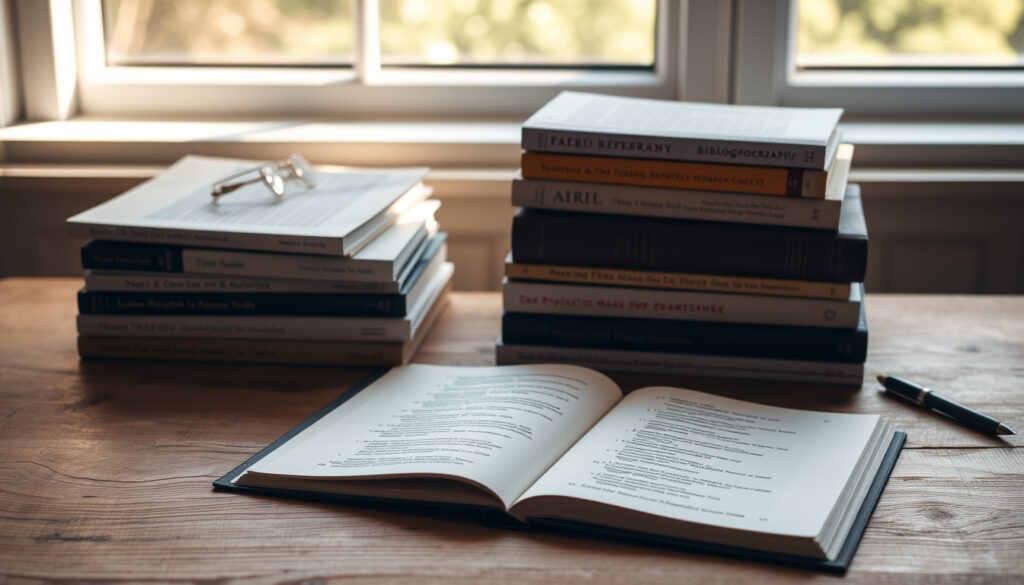
What Is a Bibliography? Definition, Examples, & How to Write One
A bibliography does more than list sources—it anchors academic integrity and lets readers verify your claims. This guide covers the definition, examples in APA and MLA, and step-by-step instructions.
Common bibliography styles: APA, MLA, Chicago, Harvard ·
Typical number of sources in a project bibliography: 8–15 ·
Key elements in a bibliographic entry: Author, Title, Publication Date, Publisher, Location
Quick snapshot
- A bibliography is a list of sources used in academic work (Merriam-Webster).
- The four main types are enumerative, analytical, descriptive, and textual (Encyclopaedia Britannica).
- Whether a bibliography should include sources only read but not cited varies by style guide (University of Iowa).
- The exact origin of the first bibliography is debated among historians (Encyclopaedia Britannica).
- Whether AP style is used for bibliographies is unclear; APA, MLA, Chicago are common (EasyBib).
- The concept of bibliography dates back to ancient Greek and Roman libraries (Encyclopaedia Britannica).
- Understanding different bibliography types helps you choose the right format for your research paper (eGyanKosh).
Four key details, one pattern: bibliography is both a practical tool and a scholarly discipline.
| Field | Value |
|---|---|
| Definition | A list of sources used in academic writing (Cambridge Dictionary) |
| Purpose | Give credit to authors and allow verification (Editage) |
| Common styles | APA, MLA, Chicago, Harvard (EasyBib) |
| Typical components | Author, title, date, publisher, URL (Cascade Highline Schools) |
What is a bibliography and example?
Definition of a bibliography
A bibliography is a systematic list of all the sources—books, articles, websites, interviews—consulted or cited in the preparation of a written work. Merriam-Webster defines it as “the list of works referred to in a text or consulted by the author.” Oxford Learner’s Dictionaries adds that it can also refer to the study of books and their history.
The implication: a bibliography is both a record of your research journey and a scholarly discipline in its own right.
Example of a bibliography entry
Here is a typical entry in APA 7th edition format:
- Smith, J. A. (2020). Title of Book. Publisher Name.
- In MLA 9th edition, the same entry would appear as: Smith, John A. Title of Book. Publisher, 2020.
Sources: EasyBib (citation tool) and University of Iowa Writing Center.
Why use a bibliography?
Using a bibliography allows readers to locate the original sources you used, validates your research, and gives proper credit to other authors. Editage notes that it is an organized list of every source consulted or cited in academic or professional writing. Without it, you risk plagiarism and weaken your credibility.
A bibliography is not just a formality—it’s a signal that you’ve done your homework. For students, skipping it means losing marks; for researchers, it means losing trust.
The takeaway: a bibliography serves both as a record of sources and a marker of academic diligence.
How do I write a bibliography?
Steps to create a bibliography
- Collect every source you cited or consulted while writing your paper.
- Organize the entries alphabetically by the author’s last name (or by title if no author is listed) as advised by Cascade Highline Schools.
- Choose the correct style guide (APA, MLA, Chicago, Harvard) and apply its formatting rules consistently.
- Double-space the entire bibliography page and use a hanging indent for each entry, per Cascade Highline Schools.
- Proofread each entry for punctuation, capitalization, and italics.
Formatting rules by style
Each style has specific rules for punctuation, order of elements, and capitalization. For example, APA uses the author-date format, while MLA uses an author-page number system. EasyBib provides style-specific templates for APA, MLA, and Chicago.
Common elements across all styles include author name, title, publication date, publisher, and location.
Common mistakes
- Mixing up the order of elements (e.g., putting the date before the title in APA).
- Forgetting to include the URL or DOI for online sources, as Editage emphasizes.
- Inconsistent use of italics, quotation marks, or punctuation.
The most common mistake students make is treating the bibliography as an afterthought. Allocate time to format it correctly—your grade depends on it.
The pattern: careful formatting prevents lost marks and builds credibility.
Is bibliography the same as reference?
Bibliography vs. Reference list
A bibliography includes every source you consulted or read during your research, even if you didn’t directly cite it in the text. A reference list, by contrast, includes only the sources you actually cited. Oxford Learner’s Dictionaries distinguishes the two: a bibliography is a list of works on a subject or by an author, while a reference list is specifically tied to citations in the text.
Three key differences, one pattern: bibliography is broader, reference list is narrower.
| Feature | Bibliography | Reference List |
|---|---|---|
| Definition | List of all sources consulted (Merriam-Webster) | List of sources cited in text (Cambridge Dictionary) |
| Inclusions | All read and cited sources | Only cited sources |
| Purpose | Show research breadth and give credit | Allow readers to trace specific citations |
The trade-off: a bibliography demonstrates thoroughness, while a reference list keeps the focus on your argument.
Key differences
The main difference is scope. A bibliography is comprehensive; a reference list is selective. Encyclopaedia Britannica notes that bibliography can also mean the study of books as tangible objects, which is a separate academic field.
When to use each
Use a bibliography for research papers, dissertations, and projects where you want to show all the material you consulted. Use a reference list for journal articles and shorter papers where you only cite sources you directly quote or paraphrase.
What are the four types of bibliography?
Enumerative bibliography
Enumerative (or systematic) bibliography lists sources by author, subject, or date. Encyclopaedia Britannica describes it as a descriptive list of works on a particular subject or by a particular author.
Analytical bibliography
Analytical (or critical) bibliography studies the physical aspects of books—paper, typography, binding—to understand their production and history. Britannica emphasizes that it treats books as tangible objects.
Descriptive bibliography
Descriptive bibliography provides detailed physical descriptions of books, including collation, format, and illustrations. INFLIBNET lists it as one of the four main types in use by the early 20th century.
Textual bibliography
Textual bibliography compares different versions of a text to establish the most authoritative edition. eGyanKosh identifies it as one of five popularly known types.
The catch: while enumerative bibliography is what most students use, the other three types are specialized fields within library science and literary studies.
What should a bibliography contain?
Essential elements of a bibliographic entry
- Author name(s) – last name first, followed by first name or initials.
- Title of the work – italicized for books, in quotation marks for articles.
- Publication date – year for books, full date for articles.
- Publisher name and place of publication.
- DOI or URL for online sources.
Cascade Highline Schools provides a basic format: author, title, place, publisher, year. Editage adds that sources can include books, journal articles, reports, websites, films, interviews, and archival documents.
Order of information
Entries are typically arranged alphabetically by the author’s last name. If no author is listed, use the first significant word of the title. University of Iowa advises that a bibliography should include all relevant material drawn upon, not just works cited.
Punctuation and formatting
Each style has its own punctuation rules. For example, APA uses a period after each element, while MLA uses a period only at the end. The bibliography page should be double-spaced with a hanging indent.
Confirmed facts
- A bibliography is a list of sources used in academic work (Merriam-Webster).
- The four main types are enumerative, analytical, descriptive, and textual (Encyclopaedia Britannica).
- Whether a bibliography should include sources only read but not cited varies by style guide (University of Iowa).
- The exact origin of the first bibliography is debated among historians (Encyclopaedia Britannica).
- Whether AP style is used for bibliographies is unclear; APA, MLA, Chicago are common (EasyBib).
The core takeaway: a bibliographic entry must include author, title, date, publisher, and location, consistently formatted.
Expert perspectives
“A bibliography is a list of all the sources you used to write a paper or article. It helps readers understand where your information came from and gives credit to the original authors.”
“A bibliography is a complete list of all the sources you consulted, not just the ones you cited in your text. It shows the depth of your research.”
“In the Harvard system, the bibliography is linked to in-text citations, providing full details of each source so the reader can locate them easily.”
For students, mastering the bibliography is not just about avoiding plagiarism—it’s about building a foundation of academic integrity that will serve them throughout their education. The choice is clear: learn to do it right, or risk losing credibility.
Frequently asked questions
What is a bibliography for a school project?
A bibliography for a school project lists all the sources you used to research the project, including books, websites, and encyclopedias. It follows a specific style (usually MLA or APA) and is placed at the end.
What is a bibliography of a person?
A bibliography of a person is a list of works by or about that person. It can be used in biographical research to track an author’s publications.
What is a bibliography in an essay?
In an essay, a bibliography is a list of all sources consulted or cited, placed at the end. It provides full bibliographic details so the reader can verify the sources.
What is a bibliography in a presentation?
In a presentation, a bibliography is a slide at the end listing the sources used. It may include only the key sources to keep the slide readable.
What is another term for bibliography?
Other terms include “reference list,” “works cited,” “sources consulted,” or “list of references.” However, the exact meaning varies by style guide.
What is a list in a bibliography called?
Each entry in a bibliography is called a bibliographic entry or citation. The entire list is the bibliography.
The bottom line: understanding these FAQs helps clarify common confusions about bibliography usage.
For any student or researcher, mastering the bibliography is an essential step toward credible, ethical academic work.
Related reading
More related posts
 2 Oz to Ml – Precise US and UK Conversions
 What Is a Secondary Source – Definition, Examples and Differences
 Panama City Beach Weather: Best Times, Forecast & Safety Guide
 How to Watch Thursday Night Football: 2026 Guide for Every Option
 What Is No Kings Act – Schumer’s Challenge to Presidential Immunity
 Lowe’s Credit Card Login: How to Access Your Account
 Manuel Garcia-Rulfo: Career, Biography, and 2025 Updates