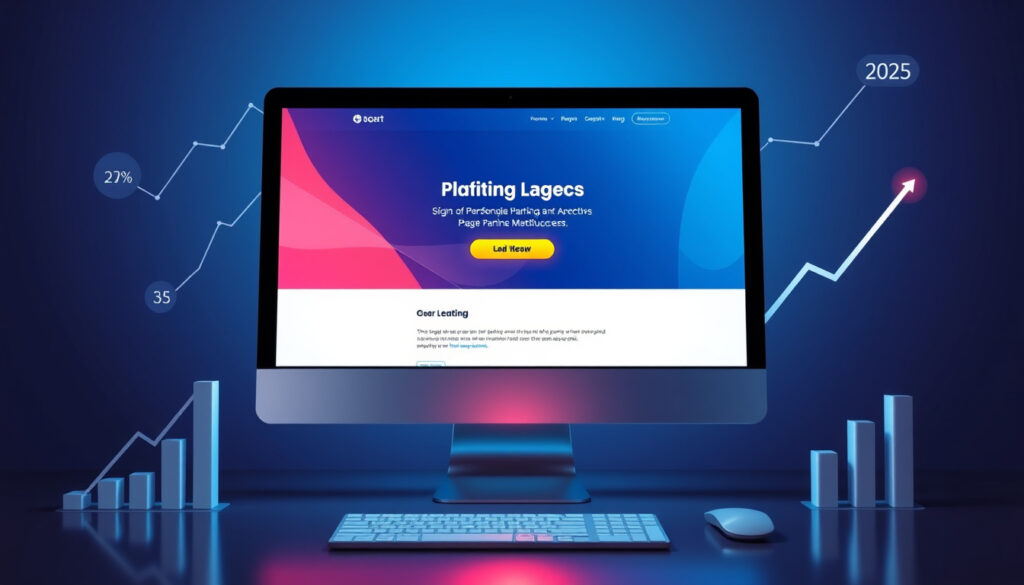
What Is a Landing Page Conversion? Rate, Benchmarks 2025
If you’ve ever wondered why two landing pages can pull the same traffic but produce wildly different results, the answer usually comes down to one metric. A landing page conversion measures how effectively a page turns visitors into action-takers — and that number separates campaigns that justify their spend from those that quietly drain it. Below, you’ll find what CVR actually means, where industry benchmarks sit in 2025, and the concrete levers that move the needle.
Core Definition: Visitors completing call-to-action · CVR Formula: (Conversions / Visitors) x 100 · Average Benchmark: 2-5% across sectors · Strong CVR: Above 10%
Quick snapshot
- Google Ads average CVR 2025 is 7.52% (NudgeNow)
- Unbounce median landing page CVR all industries is 6.6% (Grow-Conversions)
- WordStream median landing page CVR is 2.35%, top 25% 5.31% (WordStream)
- Exact “good” rates vary by niche — benchmarks give ranges, not absolutes
- 2026 projections lack sufficient data beyond early snapshots
- Limited mobile vs desktop CVR splits in available research
- Unbounce 2024 Conversion Benchmark Report set current baseline
- IRP captured Dec 2025 snapshot showing category shifts
- TheeDigital tracked YoY CVR changes from 2024 to 2025
- Education instruction CVR jumped from 7.91% to 11.38% — biggest YoY gain
- APAC eCommerce CVR trending toward 2.5% (vs 3%+ Americas/EMEA)
- B2B SaaS self-serve pages showing 4-10% median range
| Metric | Value | Source |
|---|---|---|
| Standard CVR | Percentage of action completers | Industry definition |
| Lead Types | Sales, enquiries, bookings | Standard practice |
| Key Driver | Warm leads over design | GrowthHacking community |
| Goal Action | Register, sign up, purchase | Standard practice |
What is a conversion on a landing page?
A landing page conversion occurs when a visitor completes the specific action the page was designed to prompt — whether that’s filling out a form, signing up for a webinar, or making a purchase. According to NudgeNow (optimization analytics platform), this metric shows the number who completed the call-to-action out of total visitors, turned into a percentage by dividing conversions by visitors and multiplying by 100.
How is it measured?
The CVR formula is straightforward: (Conversions ÷ Total Visitors) × 100. For example, if 10,000 visitors land on your page and 500 complete the desired action, your conversion rate is 5%. Analytics tools like Google Analytics track these sessions automatically once goals are configured. The beauty of this metric is its universal applicability — it works identically whether you’re measuring newsletter signups, quote requests, or product purchases.
Why does it matter?
CVR answers the question every marketing dollar must face: is this campaign actually producing results, or just generating vanity traffic? A page might attract thousands of clicks from an expensive ad, but if visitors leave without converting, those clicks represent wasted spend. Understanding CVR lets you compare channels fairly — a page with 500 visitors converting at 10% outperforms one with 5,000 visitors at 1%, despite the raw traffic difference.
What does a landing page mean?
A landing page is a dedicated web page built around a single objective, distinct from your homepage which tries to serve multiple audiences at once. As Realnet (digital agency) explains, landing pages strip away navigation distractions and focus visitors entirely on one offer, one form, one call-to-action.
Key elements of landing pages
- Single focus: No menu bars, no sidebar links — just the path to conversion
- Compelling headline: Directly states the offer’s value proposition
- Clear CTA button: Action-oriented text like “Get My Free Quote” or “Reserve Your Spot”
- Trust signals: Testimonials, security badges, or brand logos
- Minimal form fields: Ask only for information you need
Difference from homepage
Your homepage is a highway junction pointing visitors toward many destinations. A landing page is a dead end with one exit — and that exit is your conversion goal. Homepage visitors can wander into the blog, browse products, or check job listings. Landing page visitors face a binary choice: convert or leave. This simplicity is precisely why landing pages consistently outperform homepage redirects for campaign traffic.
What does high CVR mean?
A high conversion rate means your landing page is performing above the typical range for your industry — visitors aren’t just arriving, they’re completing the intended action. According to Grow-Conversions (marketing optimization blog), landing pages converting above the top quartile represent strong performance: “If you’re above the industry average but below the top quartile, you have room to grow.”
Factors driving high CVR
The Reddit GrowthHacking community consistently points to one factor outweighing design polish: warm leads. A visitor who arrives via a targeted search ad for “project management software free trial” is already primed to convert compared to someone who stumbled onto a generic landing page from social media. Beyond traffic quality, high-performing landing pages share these characteristics:
- Page load speed under 3 seconds
- Mobile-optimized design
- Copy that matches the ad’s promise exactly
- Social proof specific to the offer
- Reduced friction in any forms or checkout flows
Common benchmarks
Industry benchmarks give context, though they vary significantly. The WordStream marketing data provider reports Beauty & Personal Care CVR at 7.82%, while Animals & Pets leads all industries at 13.07%. Education Instruction hit 11.38% in 2025 — the biggest year-over-year gain tracked by TheeDigital (digital marketing agency). Generally, anything above 5% starts entering “above average” territory across most industries.
High CVR isn’t magic — it’s the result of matching the right traffic with the right message. Warm leads from intent-based campaigns consistently outperform cold traffic, which means your landing page optimization efforts should start upstream.
What’s a good conversion rate for a landing page?
Industry data paints a wide range. The Ruler Analytics research platform found the average CVR across 14 industries is 2.9%, while SpeedCommerce (IRP ecommerce platform) documented December 2025 snapshots showing Toys & Games at 3.21%, Fashion at 2.15%, and Baby & Child products at just 0.52%.
By industry
Different sectors see radically different conversion behaviors based on purchase complexity, price point, and customer trust cycles. According to NudgeNow, Personal Care Products convert around 6.8% while Electronics and Appliances average 3.6% and Food & Beverage e-commerce sits at 1.39%. Webinar registration pages tell a different story entirely — LanderLab (landing page blog) reports GetResponse average CVR of 22.84% for opt-in pages, noting that “webinar pages are consistently among the highest-converting page types.”
2025-2026 averages
The most reliable 2024 benchmarks from WordStream show landing pages averaging 2.35% across all industries with the top 25% hitting 5.31%. General e-commerce runs 1.5–3.0% with top performers reaching 5.0%, while email traffic consistently outperforms at 5.0–12.0%. Regional data from Replo (ecommerce optimization platform) shows Americas and EMEA averaging above 3% while APAC trends closer to 2.5%.
Comparing your landing page against an industry average that doesn’t match your traffic source or product category sets you up for frustration. Email traffic landing pages regularly hit 10%+ not because of superior design, but because those visitors are already engaged.
What are 5 examples of conversion?
Conversions take many forms depending on business model and campaign goals. The definition is simple — any visitor completing a desired goal — but the specific actions vary widely across industries and page types.
Lead forms
A visitor fills out a contact form, quote request, or information intake form. This might be a “Request a Demo” form for SaaS software or a “Get a Quote” form for insurance. Mailchimp (email marketing platform) defines conversions as when a visitor completes a desired goal like signing up, making these lead forms the backbone of B2B landing page strategy.
Sign-ups
Email newsletter subscriptions, free trial activations, or account registrations all count as sign-up conversions. Webinar registration represents a specific variant that performs exceptionally well — LanderLab found webinar pages averaging 22.84% CVR because registrants have already decided to invest time in your content.
Purchases
Direct sales completed on the landing page or immediately post-click represent the most direct conversion. E-commerce landing pages might feature a single hero product with an “Add to Cart” button. Average e-commerce CVR sits around 4.3% according to LanderLab, though food and beverage e-commerce runs lower at 1.39% as tracked by NudgeNow.
The highest-converting page types share a common trait: visitors have already crossed the mental threshold of “am I interested?” and are now in execution mode. Webinar signups, free trials, and direct purchases from warm traffic consistently outperform cold outreach forms.
How to build a landing page that converts
Building a landing page that actually converts requires systematic steps rather than guesswork. The process starts with knowing exactly what you’re measuring and ends with ongoing optimization based on real data.
Step 1: Define your conversion goal
Before designing anything, specify one primary conversion action. “Get more customers” isn’t a goal — “Generate 50 qualified leads per month from the Q2 webinar campaign” is. Set your primary conversion in Google Analytics as a Goal, and ensure your tracking code captures the destination URL or event that signals completion.
Step 2: Match landing page to traffic source
Your landing page copy must mirror the ad or link that brought visitors there. If your Google Ads headline says “Affordable Project Management Software,” your landing page headline must say the same thing — not a generic brand tagline. Mismatched expectations are the primary reason high-intent traffic fails to convert.
Step 3: Optimize for single action
Remove every link, menu item, and distraction that doesn’t support your conversion goal. Strip the navigation bar. Hide footer links. Remove sidebar elements. Your landing page should have exactly one path forward: the conversion action you want visitors to take.
Step 4: Reduce form friction
For lead generation pages, every form field you add reduces completion rates. Research shows name and email are often sufficient for initial contact. Reserve phone number and company size questions for follow-up conversations. For purchase pages, ensure checkout flow is fast — a single-page checkout outperforms multi-step processes.
Step 5: Add trust signals strategically
Place testimonials, client logos, and security badges near your CTA button rather than burying them elsewhere on the page. Social proof works best when it addresses the specific objection a visitor might have at the moment of decision.
Step 6: Test and iterate
Run A/B tests on headlines, CTA button text, button colors, and form lengths. Even small changes — testing “Get Your Free Quote” against “Request Pricing” — can shift CVR by meaningful percentages. According to WordStream, top 25% performers maintain 5.31% CVR partly through continuous optimization rather than one-time design perfection.
Upsides
- Clear CVR measurement validates marketing spend
- Focused pages outperform homepage redirects
- Optimization is systematic and testable
- Benchmarks exist across industries for comparison
Downsides
- Low-tier traffic can drag down even great pages
- Benchmarks vary too widely for direct comparison
- Over-optimizing for one metric may hurt others
- Mobile vs desktop splits remain underreported
What drives landing page conversions?
Understanding the factors that move CVR matters more than knowing the benchmark numbers themselves. Traffic source quality, page design, and offer relevance each play distinct roles.
Traffic source impact
According to NudgeNow, email channel CVR averages 5.9% for e-commerce, 2.8% B2C, and 2.4% B2B. Paid search sits at 2-3% for e-commerce overall but Google Ads specifically averages 7.52% in 2025 as tracked by TheeDigital (digital marketing agency). Organic search CVR ranges 2-4% across consumer and business segments.
Design elements that matter
Research from Grow-Conversions shows email traffic landing pages convert at 5.0-12.0% partly because those visitors already know the brand. For cold traffic landing pages, page speed, mobile optimization, and clear value propositions matter more than visual design complexity.
With the average eCommerce landing page converting at 12.9%, there’s a significant opportunity to outperform industry benchmarks.
— NudgeNow (Optimization Analytics Platform)
Webinar pages are consistently among the highest-converting page types.
— LanderLab (Landing Page Blog)
The implications are straightforward: landing page conversions aren’t mysterious — they’re the result of matching the right offer to the right audience at the right moment. Industry benchmarks provide context, but the actual path to higher CVR runs through traffic quality, message match, and continuous testing rather than chasing arbitrary percentage targets.
For marketers launching campaigns in 2025, the decision point is clear: invest in traffic qualification before blaming page design, or watch CVR stay stuck below industry average despite endless optimization attempts.
Related reading: Landing page conversion rate benchmarks · Conversion rate calculator examples
Before diving into conversion rates and benchmarks, grasp what a landing page is along with key differences from other pages to optimize effectively.
Frequently asked questions
How do you calculate landing page CVR?
The formula is (Conversions ÷ Total Visitors) × 100. For example, 500 conversions from 10,000 visitors equals a 5% CVR. Set up goals in Google Analytics to track this automatically.
What factors improve landing page conversions?
Traffic source quality matters most — warm, intent-based leads convert better than cold traffic. For the page itself, reduce friction, match ad copy exactly, optimize load speed, and remove navigation distractions.
What is a landing page conversion template?
A conversion template is a reusable landing page structure with proven elements: compelling headline matching your offer, single CTA button, minimal form fields, and trust signals near the conversion point.
Why do warm leads convert better?
Warm leads have already decided they’re interested before arriving. They found your page via a targeted search or clicked an email link about a specific topic they care about. Cold traffic still needs convincing about the problem and solution.
How does traffic source affect CVR?
Email traffic averages 5.9%, Google Ads 7.52%, and organic search 2-4%. The same landing page will show dramatically different CVR depending on which channel sends visitors — that’s why channel-specific benchmarks exist.
What tools track landing page conversions?
Google Analytics Goals, Google Tag Manager, HubSpot tracking, and platform-specific tools like Unbounce or WordStream provide CVR dashboards. The key is ensuring your goal captures the exact action you defined as a conversion.
Is 5% CVR above average?
Yes. The WordStream average across industries is 2.35%, with top 25% at 5.31%. A 5% CVR puts you in the top quartile for most industries, though webinar and email landing pages regularly exceed 10%.
More related posts
 iPhone 11 Release Date: Support Timeline & 2026 Viability
 The World Is Yours: Meaning, Origin, and Cultural Impact
 Joke of the Day: Short, Hilarious Jokes for Everyone
 Sphere Las Vegas Tickets 2026: Prices & Best Seats
 Does Target Price Match – What You Need to Know
 Rug Cleaning Near Me – Costs, Methods and Local Tips
 iPhone 16 Pro Max Ireland: Price, Specs & Should You Buy in 2025
 Dave Ramsey Investment Calculator – Complete Guide to Baby Step 4