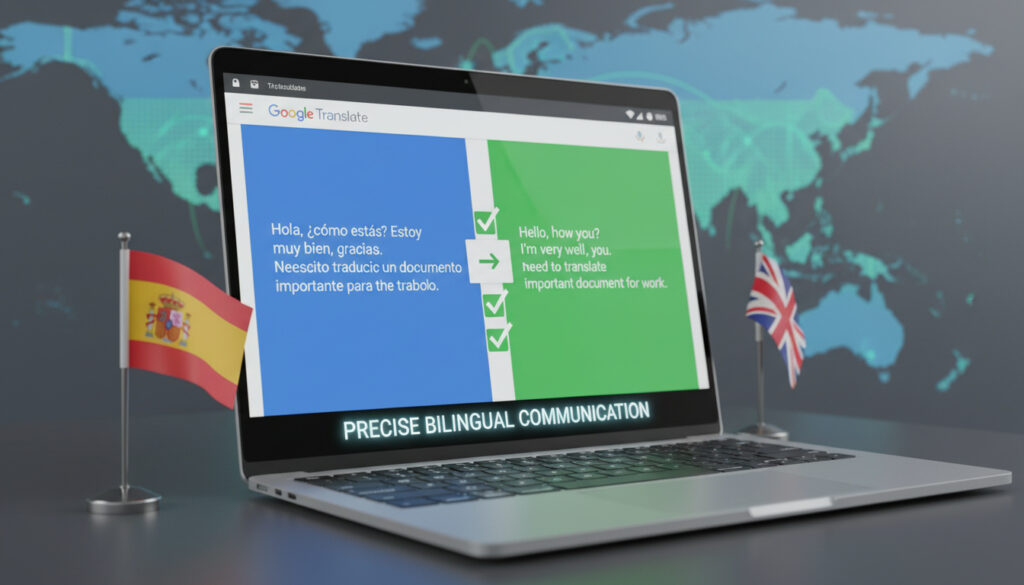
Google Translate Spanish to English – Free Guide to Accuracy and Use
Google Translate processes Spanish-to-English conversions through neural networks trained on vast bilingual datasets, delivering approximately 90% accuracy for straightforward text. The service remains free and accessible across web browsers, iOS, and Android devices, supporting text, voice, image, and document inputs.
Users encounter varying degrees of precision depending on content complexity. Simple phrases like directional requests translate reliably, while idiomatic expressions and regional dialects present consistent challenges. The platform switched from statistical models to Neural Machine Translation in 2016, fundamentally reshaping how it handles the Spanish-English language pair.
Recent analyses through 2025 confirm the tool maintains strong performance for European languages, though human review remains essential for professional, legal, or marketing materials. Understanding specific capabilities and boundaries allows users to maximize utility while avoiding critical errors.
How to Use Google Translate for Spanish to English Translations
Available on translate.google.com, iOS, and Android without cost.
Type, speak, upload documents, or scan images for instant conversion.
No registration required; processes translations in real-time.
Comprehensive coverage including multiple Spanish variants.
- Achieves 90%+ accuracy for simple, literal Spanish text
- Neural Machine Translation (NMT) reduces errors by 55-85% compared to pre-2016 models
- Document uploads supported up to 10MB (PDF, DOCX)
- Voice input enables real-time conversation mode
- Offline functionality requires downloading Spanish-English language packs
- Camera translation decodes signs and menus visually
- Dialect handling remains limited for regional slang
| Feature | Details |
|---|---|
| Languages | Spanish (multiple variants) to English |
| Accuracy | 90%+ for simple text; 80-90% for complex sentences |
| Cost | Free |
| Devices | Web, iOS, Android |
| Max File Size | 10MB for documents |
| Core Technology | Neural Machine Translation (NMT) |
Accessing the tool requires selecting Spanish as the source language and English as the target on the Google Translate interface. Users may enter text manually, tap the microphone icon for speech input, or upload files directly. The mobile application offers additional functionality including handwriting recognition and camera-based live translation.
Is Google Translate Accurate for Spanish to English?
Current Accuracy Benchmarks
Research from UCLA in 2021 found Google Translate preserved meaning in 82.5% of tested cases overall, with Spanish-to-English performing at the higher end of the 55-94% range. Smartling analysis confirms the language pair consistently achieves 90% accuracy for straightforward vocabulary and simple sentences, outperforming less-resourced language combinations due to abundant training data.
Performance metrics shift based on content type. Timekettle assessments indicate complex sentences achieve 80-90% accuracy, while literary or informal text drops to approximately 72%. Medical and legal domains show variable results, with some studies citing 82.5% accuracy for clinical content.
Persistent Limitations
The system struggles with contextual nuance and cultural idioms. Phrases like “Estoy cayendo por ti” produce ambiguous results, potentially translating as either romantic interest or physical falling. Regional variations between Mexican and Spain Spanish default to neutral forms, frequently missing location-specific terminology.
Google Translate does not meet standards for legal contracts, medical diagnoses, or regulated marketing content without human verification. Accuracy ceiling for business-critical materials remains at 80-90% maximum.
Input quality directly affects output precision. Typos or grammatical errors in the source Spanish compound translation mistakes. The platform relies on pattern recognition rather than genuine comprehension, limiting its ability to detect sarcasm, irony, or ambiguous intent.
Key Features of Google Translate for Spanish-English
Voice and Conversation Modes
The voice input function transcribes spoken Spanish into text before translation, supporting real-time dialogue between speakers. Conversation mode enables back-and-forth exchange without manual language switching, functioning effectively for basic travel and hospitality interactions.
Document and Camera Translation
Users upload PDFs, DOCX files, or other formats up to 10MB for complete document translation while preserving original formatting. Camera capabilities allow point-and-scan translation of physical text such as street signs, menus, and printed materials, rendering augmented reality overlays instantly.
Website Integration
Entering a URL into the translation bar generates a fully rendered English version of Spanish websites. Browser extensions enable seamless integration, automatically detecting foreign content and offering translation prompts.
Use clear, grammatically correct Spanish input; provide full sentences rather than isolated words; avoid pivoting through intermediate languages; cross-check critical translations via reverse conversion.
Alternatives to Google Translate for Spanish to English
DeepL frequently outperforms Google Translate for nuanced European language pairs, offering superior context handling for Spanish-to-English conversions. Microsoft Translator provides robust document and voice integration, particularly within Office ecosystems. Dictionary-focused tools like WordReference and Reverso Context excel at regional slang and dialect-specific phrases through example-based search.
Professional localization platforms including Smartling and Phrase combine AI translation with human validation, achieving 95%+ accuracy for enterprise requirements. Hardware solutions such as Timekettle devices offer dedicated real-time voice translation beyond smartphone application capabilities.
For important translations, run text through Google Translate, then reverse-translate the English output back to Spanish. Significant deviations between original and reverse-translated text indicate potential accuracy issues requiring alternative tools.
Specialized needs may require 1 Dollar in Rupees Today – Live Rate and Analysis for financial context comparisons, though translation accuracy remains independent of currency conversion tools.
Evolution of Spanish-English Translation Technology
- : Google Translate launches with statistical machine translation supporting basic Spanish-English conversion.
- : Neural Machine Translation (NMT) rollout reduces translation errors by 55-85% for the language pair.
- : Transformer model implementation improves full-sentence context analysis.
- : Incremental improvements to dialect recognition and regional variant handling.
- : Current accuracy stabilizes at 80-90% for general Spanish-English content; no major algorithmic updates recorded for 2024.
Video testing throughout 2024-2025 demonstrates consistent performance gains in conversation mode, though nuance gaps persist compared to human translators. For a deeper dive into the latest advancements, check out the MacBook Air M3 recenzja. MacBook Air M3 recenzja
Certainties and Unknowns in Translation Accuracy
- 90%+ accuracy for simple Spanish text
- NMT technology reduces errors 55-85%
- Free access across all platforms
- Document support up to 10MB
- Offline mode requires prior download
- Specific 2024 algorithm update details
- Exact performance on rare dialects (e.g., Argentinian slang)
- Long-term accuracy trends for informal language
- Precision rates for emerging neologisms
How Neural Processing Handles Spanish to English
Google Translate employs Neural Machine Translation systems that analyze entire sentences simultaneously rather than word-by-word processing. Spanish and English share structural similarities as Indo-European languages, facilitating higher accuracy compared to linguistically distant pairs. The Transformer architecture, implemented in 2018, weighs contextual relationships between words across full phrases.
Training data abundance drives the Spanish-English pair’s reliability. As two of the world’s most widely spoken languages, the corpus includes extensive parallel texts from literature, legal documents, and web content. However, the system identifies statistical patterns rather than comprehending semantic meaning, explaining failures with culturally embedded expressions.
Users seeking financial data conversions might reference 1 Dollar in Rupees Today – Live USD to INR Exchange Rate when working with multilingual economic documents, ensuring numerical accuracy alongside linguistic translation.
Expert Assessments and Research Findings
“Meaning preservation in Spanish-to-English translation reaches 82.5% overall, with simple sentences approaching 94% accuracy while complex literary text drops significantly.”
— 2021 UCLA Translation Study
“Spanish-English remains Google’s strongest language pair due to data abundance, though the system cannot reliably handle regional idioms or professional contexts without human oversight.”
Summary
Google Translate delivers reliable Spanish-to-English conversion for everyday communication, travel, and basic document review, maintaining 90% accuracy on straightforward text while struggling with dialects and idioms. The free service supports multiple input methods including voice, camera, and document upload, though professional applications demand human verification. 1 Dollar in Rupees Today – Live Rate and Analysis illustrates how specialized tools complement translation services for specific domain requirements.
Frequently Asked Questions
Can I use Google Translate for free Spanish to English?
Yes. The service is free across web browsers, iOS, and Android apps with no registration required.
Does Google Translate handle Spanish dialects?
The tool defaults to neutral Spanish forms and struggles with regional variations like Mexican versus Spain Spanish or Argentinian slang.
How do I translate documents from Spanish to English?
Upload PDF or DOCX files up to 10MB through the document tab; formatting is preserved during translation.
Is voice translation available for Spanish to English?
Yes. Tap the microphone icon to speak in Spanish; the app transcribes and translates in real-time with conversation mode for dialogue.
Why does Google Translate get idioms wrong?
The system uses pattern recognition rather than cultural understanding, causing literal translations of figurative expressions.
Can I use Google Translate offline?
Yes, after downloading the Spanish-English language pack through the mobile app settings.
What is the best alternative for Spanish-English translation?
DeepL often provides more accurate nuance for European languages; professional tools like Smartling offer 95%+ accuracy with human review.
More related posts
 Weather in New York: Monthly Averages, Packing & Best Times
 Cheesy Pick Up Lines: 111 Funny Rizz for Him & Her
 Joke of the Day: Short, Hilarious Jokes for Everyone
 Sabrina Carpenter Album Cover: Controversy, Meaning & Backlash
 What Is a Secondary Source – Definition, Examples and Differences
 Who Is the New Pope? Leo XIV (Robert Prevost) Explained
 Porsche Dealer Near Me: Official Guide & Ownership Costs
 Stranger Things Season 5 Release Time: Full Schedule & Times