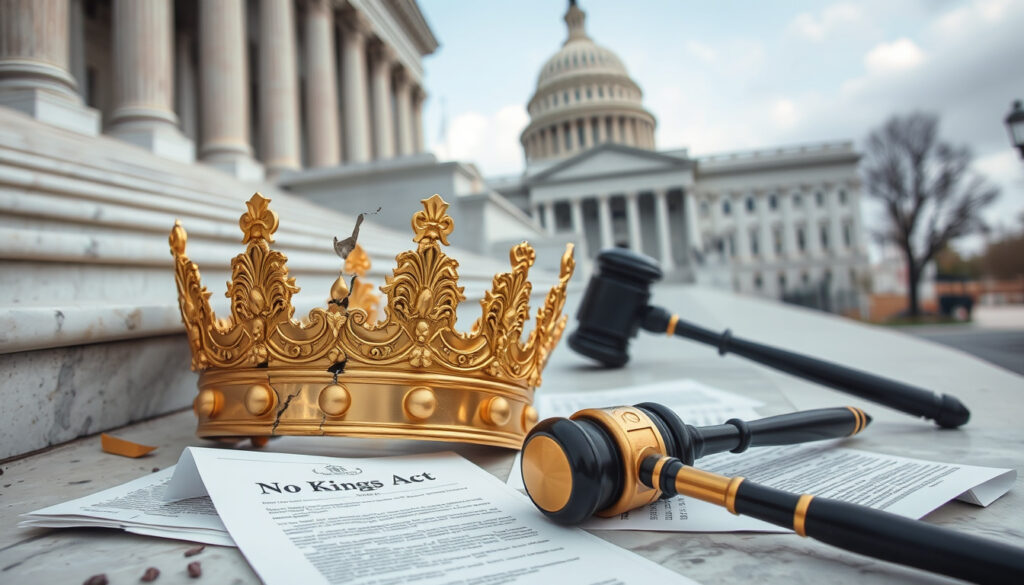
What Is No Kings Act – Schumer’s Challenge to Presidential Immunity
Senate Democrats introduced legislation in August 2024 that would fundamentally reshape how presidents can be held criminally accountable in federal court. The No Kings Act, officially designated S. 4973, emerged as a direct response to a landmark Supreme Court ruling that granted sweeping immunity protections to sitting and former presidents.
The bill seeks to overturn parts of the Court’s decision in Trump v. United States through statutory authority rather than constitutional amendment. Senate Majority Leader Chuck Schumer positioned the legislation as restoring “checks on presidential immunity” and rejecting the notion that any president should operate with the legal protections historically associated with monarchs.
For those tracking how Congress responds to court decisions that expand executive power, the No Kings Act represents one of the most significant legislative challenges to presidential immunity in modern American history. Understanding its provisions, sponsors, and current status requires examining both the legal framework it seeks to modify and the political dynamics surrounding its introduction.
What is the No Kings Act?
The No Kings Act is a Senate bill that would eliminate statutory immunity protections for presidents and vice presidents facing federal criminal prosecution. Introduced as S. 4973 in the 118th Congress, the legislation declares that no individual holding or who has held the office of president or vice president shall be entitled to immunity from criminal prosecution under federal law.
The bill fundamentally reasserts congressional authority over how criminal law applies to executive branch officials, explicitly rejecting the framework established by the Supreme Court’s July 2024 decision.
Key Provisions
The legislation contains three primary mechanisms designed to ensure presidential accountability:
- Immunity elimination: The bill states explicitly that no president or vice president, current or former, possesses immunity from federal criminal prosecution for any acts or omissions. This language directly contradicts the Supreme Court’s ruling that granted absolute immunity for “core official acts” and presumptive immunity for other official functions.
- Jurisdictional restructuring: The legislation removes the Supreme Court’s appellate jurisdiction over challenges to the act itself or criminal cases in which a president or vice president claims official-act immunity. Appeals would instead route to the D.C. Circuit Court, a provision proponents argue falls within Congress’s constitutional authority under the Exceptions Clause.
- Procedural framework: Prosecutions may proceed in any federal district court or the D.C. District Court. The act presumes constitutionality unless proven by clear and convincing evidence. Facial challenges must be brought within 180 days of enactment; as-applied challenges within 90 days.
Legislative Summary
The full text of the No Kings Act became available on congress.gov under S. 4973, allowing legal analysts and the public to examine its precise language. No companion legislation was introduced in the House of Representatives, meaning the bill, if passed, would apply only to federal prosecutions and would not modify state-level criminal jurisdiction.
The legislation does not create new criminal offenses. Instead, it clarifies that existing federal criminal statutes apply equally to presidential conduct, removing what supporters characterized as an unprecedented barrier to accountability.
Why Was the No Kings Act Introduced?
Senate Democrats introduced the No Kings Act specifically in response to a Supreme Court decision issued on July 1, 2024. In Trump v. United States, a 6-3 majority ruled that presidents enjoy absolute immunity from criminal prosecution for actions taken within their core constitutional powers and presumptive immunity for other official acts.
Supreme Court Ruling Context
The ruling marked the first time the Court explicitly established presidential immunity as a constitutional principle rather than a policy consideration. Chief Justice John Roberts wrote in the majority opinion that presidents require immunity for official acts to ensure they can discharge their duties without fear of political prosecution. The decision drew immediate criticism from legal scholars and Democratic lawmakers who argued it effectively placed presidents above the law.
Justice Sonia Sotomayor authored a dissent warning that the ruling meant “the President is now a king.” The phrase became a rallying point for critics and directly inspired the No Kings Act’s name. Senate Majority Leader Schumer explicitly referenced her dissent when unveiling the legislation, stating the bill would ensure America “elects presidents, not kings.”
Supporters of the bill argue the ruling could have shielded presidents for acts ranging from Watergate-era violations to hypothetical abuses of power. The legislation explicitly rejects such expansive immunity claims.
Political Motivations
The bill’s introduction came during an election year when presidential immunity remained a politically charged topic. Democrats sought to demonstrate opposition to what they characterized as judicial overreach while providing a legislative alternative to a constitutional amendment, which would require broader consensus and significantly more time to achieve.
The political calculus included messaging to voters concerned about executive power and accountability. By forcing a Senate vote, sponsors aimed to place Republicans on record regarding presidential immunity, though no floor action occurred before the 118th Congress concluded.
Who Introduced the No Kings Act and What Is Its Status?
Senate Majority Leader Chuck Schumer (D-NY) introduced the No Kings Act on August 1, 2024, exactly one month after the Supreme Court’s immunity ruling. Schumer framed the legislation as a necessary check on judicial power that he argued threatened democratic norms.
Sponsors and Cosponsors
The legislation attracted support from over 30 Democratic senators. Key cosponsors included Jack Reed (D-RI) and Sheldon Whitehouse (D-RI), both of whom have backgrounds in constitutional law and have previously championed judicial accountability measures. No Republican senators signed on as cosponsors.
The exclusive Democratic sponsorship reflected partisan divisions over the Supreme Court’s decision. While some Republican legal scholars privately questioned aspects of the ruling, no GOP lawmakers publicly endorsed legislative countermeasures. House Speaker Mike Johnson (R-LA) defended the ruling as protecting the presidency from politically motivated prosecutions.
For readers interested in related policy debates, understanding broader questions about constitutional interpretation can provide useful context for evaluating competing legal frameworks.
Current Legislative Progress
The No Kings Act was introduced but did not advance beyond initial referral to committee. No hearings, markup sessions, or floor votes occurred before the 118th Congress ended in January 2025. The legislation effectively stalled at the earliest stage of the legislative process.
The absence of committee action means the bill’s formal text remained unexamined through standard legislative review. Whether supporters will reintroduce similar legislation in the 119th Congress remains unclear based on available public statements.
The bill faced significant procedural obstacles from inception. Senate rules requiring 60 votes to advance most legislation, combined with unified Republican opposition, made successful passage unlikely under any scenario during the 118th Congress.
What Are the Potential Impacts of the No Kings Act?
The No Kings Act, if enacted, would represent the most significant modification to presidential accountability in generations. Its impact would extend beyond removing immunity protections to restructuring how courts handle challenges to executive authority.
On Presidential Immunity
The bill would eliminate the tiered immunity framework established by the Supreme Court. Presidents could face federal prosecution for actions taken while in office, regardless of whether those actions were characterized as official duties. This would restore the pre-Trump v. United States legal landscape where sitting presidents faced potential criminal exposure.
Critics of the ruling argued it created a dangerous precedent that could shield future presidents from accountability. The No Kings Act directly addresses this concern by statute, though whether courts would uphold such legislation against constitutional challenge remains contested.
Broader Implications
The jurisdictional provisions have drawn particular attention from legal scholars. By routing challenges to the D.C. Circuit rather than the Supreme Court, the bill attempts to prevent the justices from reviewing its own jurisdiction. Washington Post columnist Ruth Marcus characterized this approach as “dangerous and constitutionally questionable,” arguing it set problematic precedents for congressional control over court jurisdiction.
Supporters counter that Congress possesses broad authority to structure the federal judiciary and that historical examples support limiting Supreme Court review in specific case categories. They note the Constitution’s Exceptions Clause grants flexibility in appellate jurisdiction.
Those interested in how price matching policies at retail chains interact with federal oversight mechanisms may find these regulatory frameworks offer an instructive parallel in understanding administrative constraints.
Timeline of Events
The following chronology captures key moments in the No Kings Act’s brief legislative history and the Supreme Court ruling that prompted its introduction:
- July 1, 2024: The Supreme Court issues its ruling in Trump v. United States, establishing presidential immunity from federal criminal prosecution for core official acts.
- July 2024: Justice Sonia Sotomayor publishes her dissent warning that the ruling effectively makes presidents ” kings.” The phrase becomes widely cited by critics.
- August 1, 2024: Senate Majority Leader Chuck Schumer introduces S. 4973, the No Kings Act, with over 30 Democratic cosponsors.
- August 2024: President Biden indicates preference for a constitutional amendment rather than statutory legislation, signaling doubts about the bill’s viability.
- January 2025: The 118th Congress concludes without the No Kings Act receiving committee consideration, hearings, or floor votes.
What Is Known and What Remains Unclear
Examining the facts surrounding the No Kings Act reveals both established information and areas where uncertainty persists:
| Established Information | Uncertainties |
|---|---|
| Chuck Schumer introduced the bill on August 1, 2024 | Whether supporters will reintroduce similar legislation |
| Over 30 Democratic senators cosponsored | Legal outcome if courts review the jurisdiction strip |
| No Republican sponsors came forward | Positions of potential 2025-2026 congressional candidates |
| Full text available on congress.gov | Impact on pending federal criminal cases involving former presidents |
| Bill stalled without committee action | Constitutional analysis from non-partisan entities like CBO |
Background and Context
Presidential immunity has evolved through centuries of American legal practice without explicit constitutional provision. Early presidents operated with the understanding that criminal law applied to their conduct, though practical considerations limited prosecutions. The Watergate scandal of the 1970s brought these questions into sharp focus, as investigators examined whether sitting and former presidents could face criminal accountability.
The Department of Justice had previously maintained internal opinions suggesting sitting presidents could not be prosecuted, though these were policy positions rather than constitutional holdings. The Trump v. United States ruling elevated these policy considerations into constitutional doctrine, creating the impetus for legislative responses like the No Kings Act.
Constitutional scholars have long debated whether presidents enjoy immunity from criminal prosecution. The question involves interpreting separation of powers principles, the structure of Article II, and the relationship between the executive branch and co-equal courts. The No Kings Act represents one congressional approach to resolving this debate through statutory authority.
Sources and Quotes
“Today, Senate Democrats are introducing the No Kings Act to restore the checks and balances our Constitution demands and reject the dangerous precedent set by the Supreme Court’s immunity decision.”
— Senate Majority Leader Chuck Schumer, White House Senate press release
“The president is now a king.”
— Justice Sonia Sotomayor, dissent in Trump v. United States, July 2024
The legislation drew support from advocacy organizations including the ACLU, which launched a campaign calling for congressional action. The organization argued that statutory solutions, while faster than constitutional amendments, faced inherent limitations in overriding judicial interpretations of constitutional principles.
Summary
The No Kings Act represents the most direct congressional response to the Supreme Court’s 2024 presidential immunity ruling. Introduced by Senate Majority Leader Chuck Schumer with support from over 30 Democratic colleagues, the legislation would eliminate immunity protections and restructure court jurisdiction over related cases. The bill’s exclusive Democratic sponsorship and procedural obstacles meant it made no legislative progress before the 118th Congress concluded. Legal questions about its constitutionality remain unresolved, with experts divided on whether Congress possesses authority to strip the Supreme Court of jurisdiction in this manner. For now, the No Kings Act stands as a marker of partisan disagreement over presidential accountability rather than enacted law.
Frequently Asked Questions
Is the No Kings Act law yet?
No. The No Kings Act was introduced in the Senate but never advanced beyond initial referral. The 118th Congress ended in January 2025 without any committee action, hearings, or votes on the legislation.
How does the No Kings Act change presidential immunity?
The bill would eliminate all statutory immunity protections for presidents and vice presidents facing federal criminal prosecution. It explicitly states that no person holding or having held these offices is entitled to immunity from criminal law.
What Supreme Court case prompted the No Kings Act?
The legislation responds directly to the Supreme Court’s July 1, 2024 decision in Trump v. United States, which established absolute immunity for core presidential acts and presumptive immunity for other official functions.
Who supports the No Kings Act?
Over 30 Democratic senators cosponsored the bill, including Majority Leader Chuck Schumer, Jack Reed, and Sheldon Whitehouse. No Republican lawmakers signed on as sponsors.
Could the No Kings Act face constitutional challenges?
Legal experts have identified potential concerns about the bill’s provisions stripping Supreme Court jurisdiction. Washington Post columnist Ruth Marcus described these provisions as “dangerous and constitutionally questionable,” though supporters cite historical precedents for congressional jurisdiction limits.
What alternatives exist to the No Kings Act?
President Biden suggested pursuing a constitutional amendment instead of statutory legislation, which would require broader consensus but provide more durable solutions. The ACLU has also advocated for amendment approaches over statute-based fixes.
More related posts
 APA Title Page Format: 7th Edition Guide (Student & Professional)
 Best Universities in USA: Rankings, Prestige & Selectivity
 2 Oz to Ml – Precise US and UK Conversions
 Places to Go Near Me: Hidden Gems in Meath, Louth, Laois
 Google Translate Spanish to English – Free Guide to Accuracy and Use
 Harris Teeter Near Me: Store Locator, Hours & Weekly Ad
 Terrence Shannon Jr.: Draft, Legal Case, and NBA Rookie Season