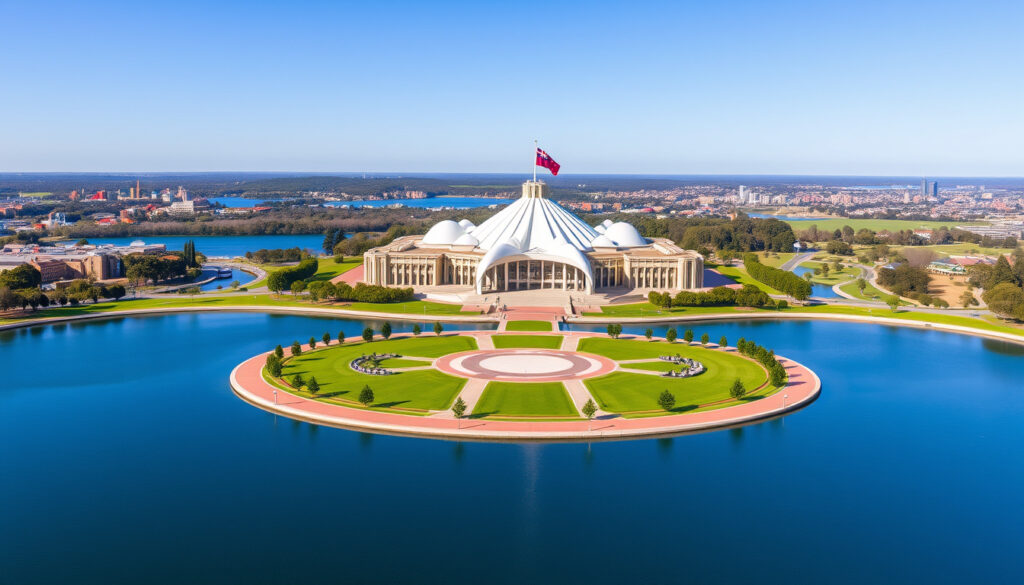
What is the Capital of Australia? Canberra, Seat of Government
Anyone who has ever glanced at a map of Australia might pause: the capital isn’t Sydney or Melbourne, the two familiar giants — it’s Canberra, a purpose-built city sitting inland, far from the coast. This article traces why that compromise happened, from federation in 1901 to the formal naming in 1913, and what makes Canberra the seat of government today.
Capital city: Canberra ·
Population (2023): Approximately 450,000 ·
Established as capital: 1913 (construction started) ·
Official transfer of government: 1927 ·
Area: 814.2 km² ·
Territory: Australian Capital Territory
Quick snapshot
- Canberra is the capital of Australia (National Capital Authority)
- It was chosen as a compromise between Sydney and Melbourne (Britannica)
- The government moved to Canberra in 1927 (National Museum of Australia)
- The exact motivations behind the selection of Canberra over other proposed sites (e.g., Dalgety, Bombala) remain debated among historians (EBSCO Research Starters)
- 1 January 1901 – Federation of Australia; Melbourne chosen as temporary capital (Wikipedia)
- 1908 – Canberra selected as site for new capital (National Capital Authority)
- 12 March 1913 – Canberra officially named (National Museum of Australia)
- 9 May 1927 – Parliament moves to Canberra (Wikipedia)
- Canberra continues to grow as the seat of federal government and the Australian Capital Territory gained self-government in 1988 (Wikipedia)
The key facts below summarize Canberra’s basic attributes.
| Attribute | Value |
|---|---|
| Official name | Canberra |
| Country | Australia |
| Territory | Australian Capital Territory |
| Founded | 1913 |
| Population (2023) | Approx. 450,000 |
| Elevation | 577 m (1,893 ft) |
What is the capital of Australia?
Canberra is the national capital
- Canberra is the capital of Australia (National Capital Authority)
- It is located in the Australian Capital Territory (National Capital Authority)
- It was chosen as a compromise between Sydney and Melbourne (Britannica)
Ask most people outside Australia about the nation’s capital and many will guess Sydney. The reality is that Canberra, a city of about 450,000, has been the seat of federal government since 1927. Its name derives from an Aboriginal word meaning “meeting place” — a fitting origin for a political centre designed to unite the country.
The National Museum of Australia notes that the naming ceremony on 12 March 1913 drew about 500 guests, 2,000 mounted troops and 3,000 observers. Lady Denman formally announced the name on Kurrajong Hill, now Capital Hill.
Canberra’s role is unambiguous: it is the national capital. The confusion around Sydney persists only because Sydney is the largest city and a state capital, but it has never been the federal capital.
The implication: The choice of Canberra resolved the Sydney-Melbourne deadlock, creating a dedicated federal capital.
Does Australia have two capitals?
National capital vs. state capitals
No — Australia has a single national capital, Canberra. Each of the six states has its own capital city (Sydney for New South Wales, Melbourne for Victoria, Brisbane for Queensland, etc.), but only one city serves as the seat of the federal government. The phrase “two capitals” sometimes arises in jest when travellers confuse state and national roles.
One national capital: Canberra
The Remitly Blog explains that the rivalry between Sydney and Melbourne was so intense that the framers of the Constitution insisted the capital be at least 160 km (100 miles) from Sydney. That constitutional requirement ensured a neutral location — and Canberra was born.
If Australia had two capitals, federal administration would be split. The single-capital model concentrates government and reinforces Canberra’s identity as the nation’s decision-making hub.
The pattern: The federal design intentionally avoids duplication of government centres.
Why is Sydney not the capital of Australia?
Sydney was never the national capital
Despite being Australia’s oldest and largest city, Sydney never served as the national capital. At federation in 1901, the government operated from Melbourne, which acted as the temporary capital while a permanent site was chosen. Sydney’s claim to capital status was rejected because choosing it would have alienated Melbourne and other states.
The rivalry with Melbourne
By the 1890s, Melbourne had surpassed Sydney in population and economic power after the gold rush. The two cities were fierce rivals, and neither would accept the other as the national seat. This deadlock forced the creation of a new city.
Selection of Canberra in 1908
The Britannica entry on Canberra notes that the site was chosen in 1909 (with the National Capital Authority confirming the 1908 selection) — a deliberate compromise situated between the two rivals. The location in the Australian Capital Territory was chosen for its temperate climate and available water supply.
The catch: The rivalry forced a new city, giving Australia a capital deliberately separate from commercial power.
Why is Canberra the capital of Australia?
A purpose-built capital
Canberra was designed from scratch. In 1911, an international design competition attracted 137 entries. The winner was American architect Walter Burley Griffin, whose plan was heavily influenced by the garden city movement. Griffin envisioned a city of wide boulevards, lakes and green spaces that aligned with natural landmarks like Black Mountain.
Official transfer in 1927
Provisional Parliament House opened on 9 May 1927, and the government officially transferred from Melbourne to Canberra. The National Museum of Australia records that the transfer ceremony was attended by thousands, marking the start of Canberra’s role as the political heart of Australia.
Canberra as the seat of government
Today, Canberra hosts Parliament House, the High Court of Australia, the Australian War Memorial, and dozens of national institutions. The city’s population has grown to around 450,000, and it remains the centre of federal decision-making.
Building a capital from scratch gave Australia a city designed for governance, but it also meant decades of slow construction — delayed by two world wars and the Great Depression — and a lingering perception that Canberra lacks the vibrancy of Sydney or Melbourne.
The implication: Canberra’s development reflects the compromises and ambitions of a young federation.
What is the capital of Australia and Sydney?
Canberra is the national capital
As we’ve covered, Canberra is the national capital. It is the heart of the federal government and the home of the Australian Parliament.
Sydney is the capital of New South Wales
Sydney, by contrast, is the state capital of New South Wales. It houses the state parliament and governor, and it handles state-level governance. Many visitors confuse the two because Sydney is Australia’s international gateway and by far the larger city.
How the two cities differ
Remitly Blog highlights that the distinction is simple: Canberra is the federal capital; Sydney and Melbourne are state capitals. One is a political centre, the other a commercial and cultural powerhouse.
The pattern: The federal and state roles are clearly separated, ending the “two capitals” myth.
Six cities, one pattern: Australia has a single national capital but six state capitals. The table below clarifies the difference.
| City | Status | Government significance |
|---|---|---|
| Canberra | National capital | Seat of federal Parliament, High Court, Governor-General (National Museum of Australia) |
| Sydney | Capital of New South Wales | Seat of NSW state government (Wikipedia) |
| Melbourne | Capital of Victoria | Seat of Victoria state government, temporary national capital 1901-1927 (Britannica) |
The implication: the “two capitals” confusion is a misunderstanding of federal vs. state roles. No other city challenges Canberra’s status as the national capital.
Timeline: How Canberra became the capital
- 1 January 1901 – Federation of Australia; Melbourne chosen as temporary capital (History of Canberra as Australia’s Capital)
- 1908 – Canberra selected as the site for the new capital (National Capital Authority)
- 12 March 1913 – Canberra officially named and construction begins (History of Canberra as Australia’s Capital)
- 9 May 1927 – Parliament moves from Melbourne to Canberra (History of Canberra as Australia’s Capital)
- 1988 – Australian Capital Territory granted self-government (History of Canberra as Australia’s Capital)
The pattern: each milestone reflects the slow, deliberate construction of a capital born from political compromise.
Confirmed facts
- Canberra is the capital of Australia (History of Canberra as Australia’s Capital)
- It was chosen as a compromise between Sydney and Melbourne (History of Canberra as Australia’s Capital)
- The government moved to Canberra in 1927 (History of Canberra as Australia’s Capital)
What’s unclear
- The exact motivations behind the selection of Canberra over other proposed sites (e.g., Dalgety, Bombala) remain debated (EBSCO Research Starters)
Perspectives on Canberra’s role
“Canberra was chosen as the seat of government because it was a compromise site, far from the rivalries of Sydney and Melbourne.”
“I have planned an ideal city of the future — a city that will be a symbol of the nation’s unity.”
— Walter Burley Griffin (via History of Canberra as Australia’s Capital)
For Australia, the decision to place the capital inland in Canberra continues to shape national identity. The city remains a purposeful symbol of unity, deliberately separated from commercial empires. For any traveller or student asking “what is the capital of Australia?”, the answer is clear: Canberra — a city built from compromise and designed for governance.
For a deeper look at the historical compromise that made Canberra the capital, see why Canberra, not Sydney.
Frequently asked questions
How do you pronounce ‘Canberra’?
Canberra is pronounced /ˈkænbərə/ (KAN-buh-ruh) in standard Australian English.
Is Canberra a city?
Yes, Canberra is a city — the national capital of Australia, located in the Australian Capital Territory.
What is the difference between a national capital and a state capital?
The national capital is the seat of the federal government (Canberra), while state capitals house state governments (e.g., Sydney for NSW).
Who designed the city of Canberra?
American architect Walter Burley Griffin won the 1911 international design competition and created the city’s master plan.
What is the Australian Capital Territory?
The Australian Capital Territory (ACT) is a federal territory that surrounds Canberra and serves as the location for the national capital.
Is Canberra a good place to live?
Canberra consistently ranks high in quality-of-life surveys, with good schools, low crime, and abundant green space.
How far is Canberra from Sydney?
Canberra is about 280 km (174 miles) southwest of Sydney — roughly a 3-hour drive.
More related posts
 Shoe Stores Near Me: Dublin City Centre Guide
 How to Cancel Audible Membership: Step-by-Step Guide (2025)
 In the Hand of Dante: Plot, Cast, Netflix Release (2025)
 60k a Year is How Much an Hour? Full Breakdown & Tax Guide
 How to Send a Letter in Ireland: An Post and UK Guide
 Is Vitamin Water Good for You? 2025 Pros, Cons, Health Facts
 Spider-Man No Way Home – Complete Guide and Analysis
 2 Oz to Ml – Precise US and UK Conversions