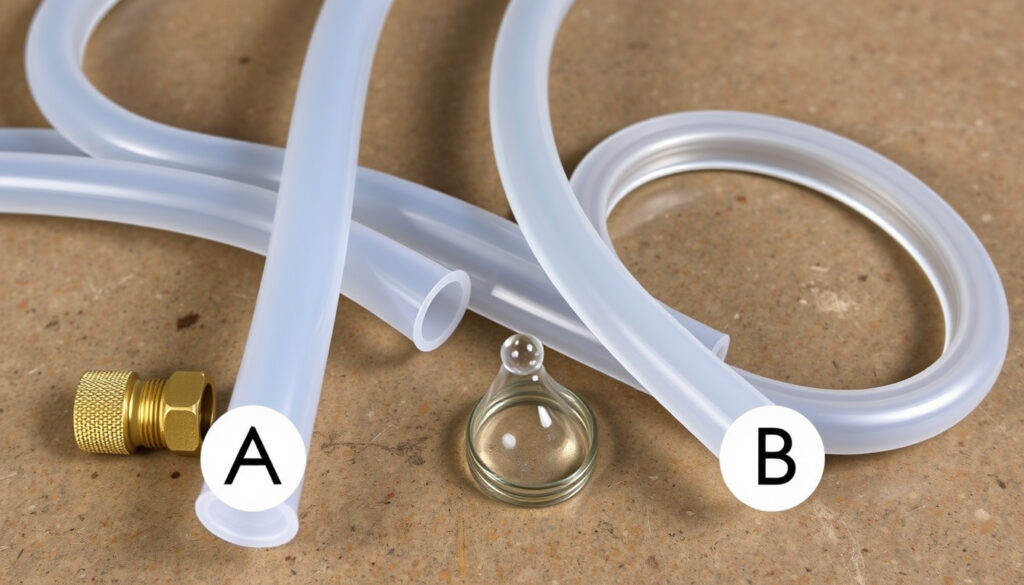
PEX A vs PEX B: Which Plumbing Tubing Should You Use
Staring at two rolls of plastic tubing at the hardware store and wondering why one costs nearly twice as much is a common frustration. PEX A and PEX B both carry water, but they’re built differently — one uses peroxide cross-linking at 85-89%, while the other cures with moisture at 65-70%.
PEX-A cross-linking degree: 85-89% ·
PEX-B cross-linking degree: 65-70% ·
PEX-A burst pressure (extreme cold): Up to 500 PSI ·
PEX-B typical warranty: 25 years ·
PEX-A flexibility: More flexible than PEX-B
Quick snapshot
- PEX-A uses peroxide (Engel) crosslinking, PEX-B uses silane moisture cure (SharkBite (plumbing manufacturer))
- PEX-A is more flexible and can make tighter radial bends (Zurn (PEX system manufacturer))
- PEX-B has been in common use in North America for over 40 years (SharkBite (plumbing manufacturer))
- Whether PEX-A’s higher cost is always worth it for residential jobs
- Long-term durability differences beyond standard warranty periods
- Impact of defective Uponor PEX-A batches on overall reliability
- Uponor addressed defective red/blue PEX-A batches with replacements and recall notices
- PEX-B remains the dominant type in North American new construction
- More stringent batch quality controls expected for PEX-A manufacturing
- Growing adoption of expansion fitting systems beyond PEX-A
Five key specs, one clear divide: PEX-A trades dollars for flexibility and burst resistance, while PEX-B offers proven reliability at a lower entry cost.
| Specification | PEX-A | PEX-B |
|---|---|---|
| Cross-linking method | Engel (peroxide) | Silane (moisture cure) |
| Cross-linking degree | 85-89% | 65-70% |
| Burst pressure (73°F) | ~480 PSI | ~400 PSI (typical) |
| Freeze resistance | Expands more before bursting | Less resilient in frigid conditions |
| Fitting system | Expansion (ASTM F1960) | Crimp/clamp (ASTM F1807/F2098) |
| Cost per foot (1/2″) | $0.50-0.70 | $0.30-0.50 |
Should you use PEX A or PEX B?
What are the differences between PEX A and PEX B?
- Cross-linking method: PEX-A is produced using the peroxide (Engel) method, while PEX-B uses silane moisture cure (SharkBite (plumbing manufacturer)). The Engel process creates more cross-linking bonds — 85-89% compared to PEX-B’s 65-70%.
- Flexibility and bending: PEX-A is routinely described as the most flexible PEX type, able to make tighter radial bends without kinking (Zurn (PEX system manufacturer)). A kinked PEX-A line can often be repaired with a heat gun; PEX-B typically requires cutting out the damaged section.
- Burst resistance in cold: PEX-A offers higher burst resistance and can reportedly withstand up to 500 PSI in extreme cold conditions (Zurn (PEX system manufacturer)).
Do most plumbers use PEX A or B?
- PEX-B is identified as the most common PEX pipe type in North America and has been in widespread use for over 40 years (SharkBite (plumbing manufacturer)).
- PEX-A has a strong following among plumbers who prioritize flexibility and freeze resistance, particularly in cold climates.
- The Wahl family and other trade-oriented resources note that PEX-A is “typically 85% – 89% cross-linked, while PEX-b is usually 65% – 70% cross-linked” (Replumb Specialties Inc. (plumbing supply)).
Homeowners in freeze-prone regions get a concrete safety margin from PEX-A’s expansion capability. Builders on volume projects get a better per-foot cost with PEX-B. Neither is wrong — the right answer depends on whether you’re protecting against a single cold snap or managing 500 units.
The implication: PEX-A wins on flexibility and freeze margin; PEX-B wins on installed cost and track record. For most homeowners, the choice hinges on climate and tool budget.
Do you crimp PEX A or B?
Can you use expansion fittings on PEX B?
- PEX-A is normally installed with expansion-style fittings (ASTM F1960) that require a dedicated expansion tool (Zurn (PEX system manufacturer)). The tool expands the fitting and tube together; the material shrinks back for a tight seal.
- PEX-B is most commonly installed with crimp or clamp fittings (ASTM F1807, F2159, F2098) using a manual crimp tool (PEX Universe (plumbing retailer)).
- According to Zurn, PEX-B can also be used with expansion fittings in some configurations, but this is not standard practice (Zurn (PEX system manufacturer)).
What tools are needed for PEX A vs PEX B?
- A Milwaukee automatic expansion tool for PEX-A runs around $250; a Zurn manual crimp tool for PEX-B costs about $150 (Williams Plumbing (trade resource)).
- PEX-A material is estimated at $0.35 per foot vs PEX-B at $0.21 per foot in some price comparisons (Williams Plumbing (trade resource)).
- PEX-A can technically be crimped, but expansion is the recommended method to leverage its material memory.
PEX-A makes you buy a $250 expansion tool before you run the first fitting. PEX-B lets you start with a $150 crimper but locks you into a fitting system that won’t give you the same burst margin. Your tool purchase is effectively a vote for one material’s physics.
The pattern: PEX-A demands higher upfront tool investment but delivers faster, more forgiving connections. PEX-B uses cheaper, simpler tools with a tighter tolerance for fitting alignment.
Can you mix PEX A and B?
Can you connect PEX-A to PEX-B?
- You can connect PEX-A to PEX-B using appropriate transition fittings — the key is matching the fitting system, not the tubing type.
- Expansion fittings on PEX-A can connect to crimp fittings on PEX-B through a standard adapter or coupling.
- Manufacturers generally advise against mixing types within a single continuous system without proper transition fittings.
What happens if you mix PEX types?
- Mixing types is physically possible if proper fittings are used for each tubing type.
- Compatibility depends on the fitting system chosen — expansion fittings need PEX-A’s material memory; crimp fittings work with both but won’t give PEX-A’s full burst advantage.
- Using PEX-B with expansion fittings may compromise the seal because PEX-B doesn’t recover its shape as effectively after expansion.
The pattern: mixing is doable with adapters, but you lose the primary advantage of PEX-A (expansion resilience) at every transition point.
How do I tell if my PEX is A or B?
What markings indicate PEX type?
- PEX tubing is marked with ASTM or CSA standards printed along the side. PEX-A is often labeled “PEX-A” or “ASTM F876.”
- PEX-B may be labeled “PEX-B” or “ASTM F877” (SharkBite (plumbing manufacturer)).
- Brand names are a shortcut: Uponor and Wirsbo produce PEX-A; SharkBite and Viega produce PEX-B.
Are there visual differences between PEX-A and PEX-B?
- PEX-A is typically more flexible and can be coiled tighter than PEX-B.
- PEX-B feels slightly stiffer to the hand bend test.
- The cross-linking method (Engel vs Silane) is the root differentiator — not the color of the pipe.
The trade-off: visual inspection alone won’t tell you for certain. Read the printed markings or check the manufacturer’s label.
Is PEX A being discontinued?
Are there defective batches of Uponor PEX-A?
- There have been reports of defective Uponor PEX-A batches, specifically red and blue tubing with certain production dates.
- Uponor addressed the issue and replaced defective batches for affected customers.
- PEX-A is not being discontinued — it remains widely available and installed in new construction.
Should I be concerned about using PEX-A?
- Check for batch numbers and any recall notices on your specific tubing before installation.
- Reputable suppliers carry current, verified stock.
- The defective batch issue does not indicate a systemic failure of PEX-A technology.
The pattern: a batch-level quality issue, not a product discontinuation. If you’re buying from a trusted distributor, PEX-A remains a valid choice.
Upsides
- PEX-A: Superior freeze and burst resistance for cold climates
- PEX-A: Kink-repairable with heat gun, saving replacement time
- PEX-B: Lower material cost per foot — typically 30-50% less
- PEX-B: Over 40 years of proven North American installation history
- Both: Compatible with standard copper and PEX transition fittings
Downsides
- PEX-A: Higher per-foot cost and $250+ expansion tool needed
- PEX-A: Recent Uponor batch quality issues raise inspection requirements
- PEX-B: Less flexible, more prone to kink damage requiring section replacement
- PEX-B: Lower burst pressure in extreme cold — up to 100 PSI less
- Both: Mixing types requires transition fittings and careful planning
“PEX-a is more flexible, and more durable. PEX-a is typically 85% – 89% cross-linked, while PEX-b is usually 65% – 70% cross-linked.”
“PEX-A offers higher burst resistance, capable of withstanding up to 500 PSI in extreme cold.”
— Zurn (PEX system manufacturer)
“PEX-B is the most commonly used PEX tubing in North America for over 40 years and typically carries a 25-year warranty.”
— SharkBite (plumbing manufacturer)
For the homeowner in a freeze zone, PEX-A’s 500 PSI burst margin isn’t a luxury — it’s the difference between a quick thaw and a basement flood. For the production builder managing 200 new homes, PEX-B’s $0.15 per foot savings adds up to thousands of dollars per project. The choice isn’t about which is “better” in a vacuum; it’s about whose risk profile fits your project.
For a detailed look at the most common dimension used in Danish installations, see our PEX 15 mm guide covering installation and durability.
Frequently asked questions
Can PEX A be used for hot water?
Yes, PEX-A is rated for both hot and cold domestic water applications. It meets ASTM F876/F877 standards for hot water distribution up to 200°F at 80 PSI.
What is the lifespan of PEX B?
PEX-B typically carries a 25-year warranty, and many manufacturers expect 40-50 years of service life under normal conditions.
Does PEX A freeze better than PEX B?
Yes, PEX-A’s higher cross-linking degree (85-89%) gives it more elasticity to expand under freezing conditions without bursting.
Are PEX A fittings expensive?
PEX-A expansion fittings cost more than standard crimp fittings, and the expansion tool adds $100-250 to the initial investment.
Can I use PEX B with expansion tools?
It’s not recommended — PEX-B lacks the material memory to recover its shape after expansion, which can compromise the seal.
Is PEX A suitable for outdoor applications?
PEX-A and PEX-B both require UV protection if installed outdoors; prolonged sun exposure degrades cross-linked polyethylene.
Can PEX A and PEX B be used together under slab?
Yes, with proper transition fittings and sleeving for slab protection — but any splice point under concrete adds a future failure risk.
More related posts
 When Does Implantation Bleeding Occur? Timing & Signs
 Lakers vs Golden State Warriors Timeline: Key Records
 Cast of the Copenhagen Test – Full Cast and Character Guide
 The Incredible Hulk Cast: 2008 Film Actors and History
 What Is a Bibliography? Definition, Examples, & How to Write One
 Why Is Soursop Not Illegal? Facts About Safety and Legal Status
 Matthew 19:26 Meaning – With God All Things Are Possible
 Dave Ramsey Investment Calculator – Complete Guide to Baby Step 4