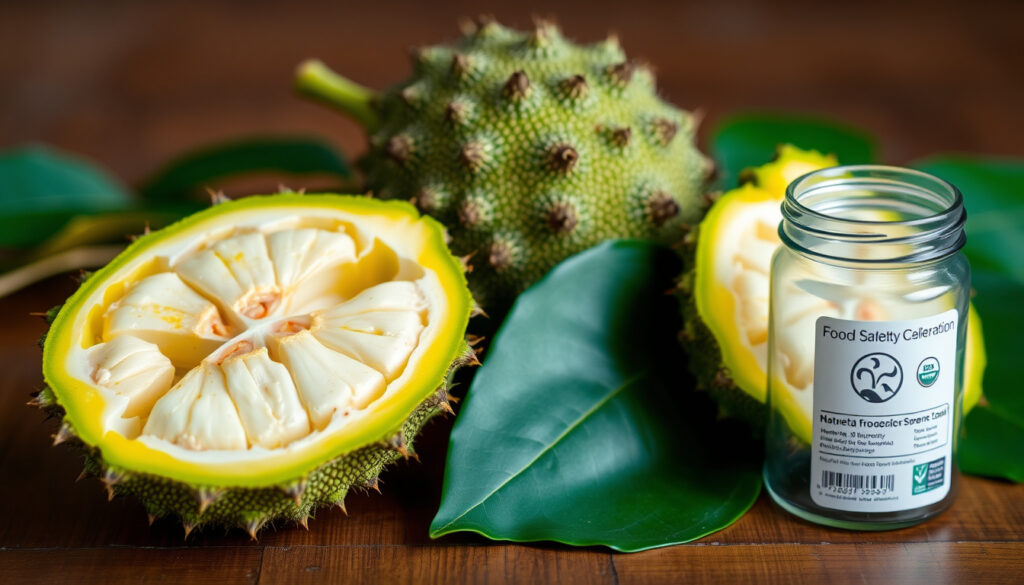
Why Is Soursop Not Illegal? Facts About Safety and Legal Status
You’ve probably seen a social media post warning that soursop is banned—or maybe you’ve heard it’s dangerous and avoided it altogether. The real story is more layered: the fruit itself isn’t outlawed in the US or the UK, but it carries genuine health risks that have prompted import restrictions and medical warnings.
Global cultivation regions: Tropical Americas, Southeast Asia ·
Oral consumption safety rating: Likely unsafe (per clinical studies) ·
US travel declaration requirement: Mandatory for all agricultural products ·
UK legal status: Legal to possess and consume
Quick snapshot
- Soursop is not banned at the federal level in the US or the UK (KeepOnHome (consumer advisory site))
- The FDA has an import alert on soursop products due to seed contamination and neurotoxins (FDA Import Alert 31-03)
- Oral consumption is classified as “likely unsafe” by clinical reviewers (FDA Import Alert 31-03) (KeepOnHome (consumer advisory site))
- Whether soursop causes liver damage in humans at typical dietary doses (KeepOnHome (consumer advisory site))
- Clinical efficacy for cancer treatment remains unproven in human trials
- Long-term safety of regular consumption of leaves or seeds is not established
- 1990: FDA import alert created after 34 people vomited within 15 minutes of drinking “Rain Drop” Guanabana Drink (FDA Import Alert 31-03) (Federal Register (USDA rulemaking))
- 2016: FDA detained soursop juice from the Philippines containing seed epidermal cells (FDA Import Alert 31-03) (Federal Register (USDA rulemaking))
- 2024: USDA proposed rule to allow fresh soursop imports from Mexico under pest-risk protocols (Federal Register (USDA rulemaking))
- Fresh soursop from Mexico may soon enter the US mainland under USDA supervision (Federal Register (USDA rulemaking))
- FDA continues to detain shipments that fail to prove absence of natural toxins (FDA Import Alert 31-03)
- More research needed on human safety of acetogenins, the active compounds in soursop
The legal landscape across six key facts shows one consistent pattern: restriction targets products, not the fruit itself.
| Fact | Detail |
|---|---|
| Scientific name | Annona muricata |
| Common English name | Soursop |
| Primary active compounds | Acetogenins |
| Oral safety classification | Likely unsafe (Cancer Treatment Centers of America, cited by FDA) |
| US legal status | Legal; declaration required for import |
| UK legal status | Legal |
Is soursop illegal in the UK?
No law in the United Kingdom makes it a crime to buy, sell, or consume soursop fruit, juice, or supplements. According to KeepOnHome (consumer advisory site), the fruit is legally available fresh, frozen, and as tea or extracts. A commercial UK retailer, Soursop UK (online fruit supplier), even advertises fresh organic soursop delivery across the country.
Soursop legal status in the United Kingdom
- Soursop is not classified as a controlled substance under the Misuse of Drugs Act
- No specific UK food ban applies to Annona muricata fruit or leaves
- Standard food safety regulations cover imported soursop products, but no additional restriction exists
Customs regulations for soursop import
- Travelers may bring soursop for personal use under the UK’s plant health rules
- Commercial imports must comply with general food law, but no special permit is required
- The UK’s Food Standards Agency has not issued a warning specific to soursop
The implication: if you live in the UK and see soursop for sale, it’s entirely legal to buy and eat.
The myth of a UK ban likely arises from US-centric health warnings that get misread as legal prohibitions. British consumers can access soursop freely, but should still be aware of the safety concerns discussed below.
Is soursop banned in the USA?
Soursop is not banned at the federal level in the United States. The confusion comes from two separate things: import restrictions on fresh fruit (enforced by USDA APHIS) and an FDA import alert on processed products that contain seed material or high levels of acetogenins.
Soursop legal status in the United States
- No federal law prohibits possession, sale, or consumption of soursop fruit inside US borders
- Fresh soursop from most countries cannot enter the US mainland because of fruit-fly pest risk, as explained by KeepOnHome (consumer advisory site)
- Frozen, canned, and processed soursop products are legally available in US stores
Declaration requirements for travelers
- Travelers returning from countries where soursop grows (e.g., Mexico, Caribbean, Southeast Asia) must declare any agricultural products to US Customs and Border Protection
- Failure to declare fresh fruit can result in fines; the fruit may be confiscated
- Processed soursop products (tea, juice, frozen pulp) are generally allowed if declared
FDA stance on soursop supplements
- The FDA does not regulate soursop supplements as drugs, but has issued Import Alert 31-03 for products containing seed cells or high acetogenin levels (FDA Import Alert 31-03)
- The alert stems from a 1990 incident where 34 people became ill after drinking a soursop beverage containing seed fragments (FDA Import Alert 31-03)
- Oral soursop is classified as “likely unsafe” by the FDA (public health regulator) based on neurotoxicity concerns
The pattern: the US restricts how soursop enters the country, not whether you can eat it once it’s here.
What are the negative effects of soursop?
Health warnings around soursop center on its acetogenins—compounds that can be toxic to nerve cells at high concentrations. The FDA (public health regulator) explicitly states that soursop fruit, leaves, and bark contain neurotoxic acetogenins associated with neurodegenerative disorders.
Movement disorders linked to soursop
- Two studies cited by the Cancer Treatment Centers of America link high oral soursop intake to atypical parkinsonism
- A 2024 analysis by KeepOnHome (consumer advisory site) reports that prolonged use of concentrated soursop extracts may cause movement abnormalities
- The exact mechanism: acetogenins inhibit mitochondrial complex I, similar to known environmental toxins
Neurotoxicity concerns
- Acetogenins in soursop seeds are present at high levels and are inedible (FDA Import Alert 31-03)
- Laboratory studies show that these compounds can cross the blood-brain barrier and accumulate in neural tissue
- Clinical data in humans remain limited, but population studies suggest a link between soursop consumption and increased risk of atypical parkinsonism in the Caribbean
Gastrointestinal side effects
- Eating large amounts of raw soursop may cause nausea, vomiting, and diarrhea due to the fruit’s high acidity and fiber content
- The 1990 FDA incident involved vomiting within 15 minutes of drinking a soursop beverage contaminated with seed cells (FDA Import Alert 31-03)
“We advise patients to avoid oral soursop products because of the risk of neurological side effects.”
Dr. Kellman, cited by the Cancer Treatment Centers of America
The trade-off: the compounds that give soursop its medicinal promise are also the ones that make it potentially dangerous.
Is soursop harmful to the liver?
Evidence on soursop and liver damage is mixed. Some animal studies suggest that high doses of acetogenins can cause hepatotoxicity, but human data are scarce.
Soursop and liver function
- According to KeepOnHome (consumer advisory site), there are case reports of elevated liver enzymes in people consuming concentrated soursop leaf tea daily for months
- The FDA’s import alert does not list liver toxicity as a primary concern, focusing instead on neurotoxicity
Acetogenins and hepatotoxicity
- In vitro studies show that acetogenins can induce apoptosis in liver cell lines at high concentrations
- No peer-reviewed human study has established a causal link between moderate soursop consumption and liver disease
Contrast with liver benefits claims
- Some traditional medicine sources claim soursop leaves support liver health, but these claims are not backed by robust clinical evidence
- The Federal Register (USDA rulemaking) notes that fresh soursop for consumption is generally considered safe for the general population when the seeds are removed
What this means: if you have a healthy liver and eat the fruit (not the seeds or leaves) in moderation, the risk appears low. But concentrated products carry more uncertainty.
What are the health benefits of soursop?
Despite the safety warnings, soursop has a long history in traditional medicine and has attracted serious scientific interest for its anticancer properties. For comparison, consumers often ask about the health profile of other beverages and supplements, such as Is Vitamin Water Good for You?.
Antioxidant properties
- Soursop pulp is rich in vitamin C, B vitamins, and dietary fiber
- Polyphenols in the fruit have demonstrated antioxidant activity in test-tube studies
Cancer research context
- Acetogenins in soursop have shown in vitro cytotoxic effects on cancer cell membranes by inhibiting NADH oxidase (FDA Import Alert 31-03)
- Graviola (soursop) is promoted as an alternative cancer therapy, but KeepOnHome (consumer advisory site) notes that no controlled human trials confirm efficacy
Traditional medicine uses
- In tropical regions, soursop leaves are brewed as tea for sedation, fever reduction, and digestive complaints
- Traditional healers use the fruit pulp for skin conditions and wound healing
Soursop offers genuine antioxidant and anticancer potential in the lab, but the same compounds carry neurotoxicity risk. Patients seeking cancer relief should not substitute soursop for proven treatments without medical guidance. Those evaluating dietary supplements may also find the review of Vital Proteins Collagen Peptides – Benefits, Usage and Reviews helpful for context.
Upsides
- Rich in vitamin C and antioxidants
- In vitro anticancer activity against multiple cell lines (FDA Import Alert 31-03)
- Traditional sedative and digestive support
- Legal to possess and consume in the US and UK
Downsides
- Likely unsafe for oral use (neurotoxicity risk) per FDA
- May cause movement disorders with prolonged consumption
- FDA import alert on products containing seed material
- No proven efficacy as a cancer treatment in humans
- Potential liver toxicity at high doses (limited evidence)
“We do not recommend graviola as a treatment for cancer because there is no reliable evidence that it works.”
Cancer Research UK
“The evidence for soursop’s anticancer activity is entirely from lab studies; we need clinical trials before any recommendation.”
Dr. Kellman, cited by the Cancer Treatment Centers of America
For anyone considering soursop for health reasons, the bottom line: the fruit itself is legal and generally safe in moderate amounts when the seeds are avoided, but concentrated extracts and regular leaf tea carry real neurological risks that outweigh unproven benefits. The FDA’s import alert is not a ban—it is a safety net for products that could contain toxic seed fragments.
Frequently asked questions
Can you buy soursop in the United States?
Yes, you can buy frozen soursop pulp, juice, and supplements in US stores. Fresh soursop is sometimes available at specialty markets, but import restrictions make it less common than other tropical fruits.
Is soursop tea legal in the UK?
Yes, soursop tea (made from leaves) is legal and sold by multiple online retailers. There is no UK regulation specifically targeting soursop leaf products.
What happens if you eat too much soursop?
Eating large amounts may cause nausea, vomiting, or diarrhea. Long-term high intake of concentrates may increase risk of movement disorders due to the neurotoxic acetogenins.
Is soursop banned in Europe?
No, soursop is not banned in the European Union. It is sold in many European countries as fresh fruit, frozen pulp, and tea. Individual member states may have import rules, but there is no EU-wide ban.
Does soursop interact with medications?
There are no well-documented drug interactions, but because soursop can affect blood pressure and sedation, consult a doctor if you take blood pressure or sedative medications.
Can soursop leaves cause side effects?
Yes, concentrated leaf tea taken daily has been linked to neurological symptoms in case reports. The FDA warns that leaves contain acetogenins that can be neurotoxic.
Is soursop fruit safe to eat raw?
The fruit pulp is safe to eat raw if the seeds are removed. Seeds are hard and contain high levels of toxins—never chew or swallow them.
More related posts
 Urgent Loans for Bad Credit in Ireland: Fast Options
 How Much Do Truck Drivers Make? 2025 Salary Guide
 How to Fold a Pocket Square: Complete Guide with 8 Folds
 Criminal Mind Sea on 17: Relea e Date, Ca t, and More
 Best AI Stocks to Buy: Under $10 and Billionaire Favorites
 Terrence Shannon Jr.: Draft, Legal Case, and NBA Rookie Season
 Why Doe My Eye Keep Twitching? Cau e & Treatment
 What time is it in Arizona? Current local time guide