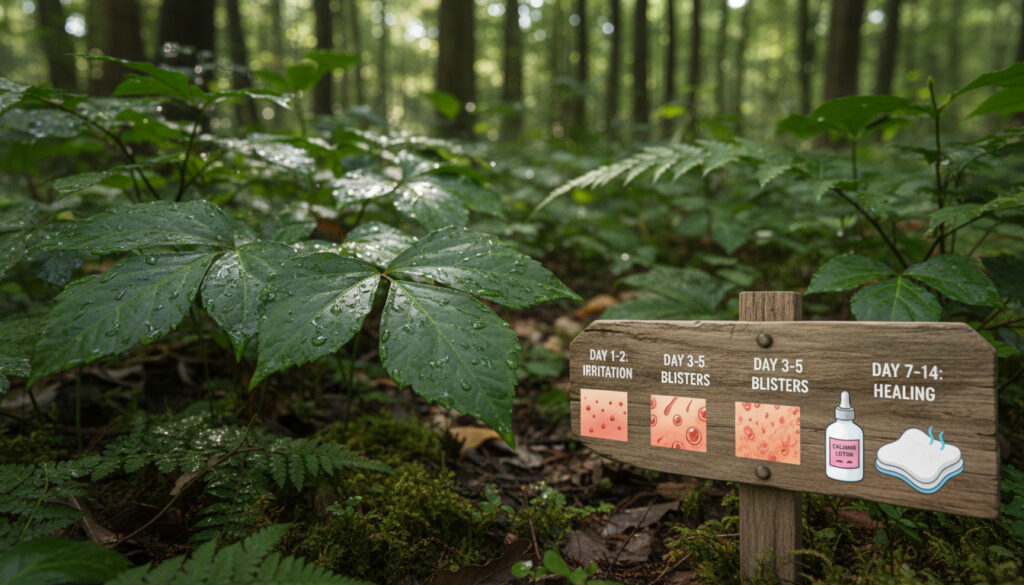
Poison Ivy Rash Stages – Timeline Symptoms and Treatment
Poison ivy rash develops through distinct phases as the skin reacts to urushiol oil, an invisible resin found in the plant’s leaves, stems, and roots. Understanding these stages helps distinguish this allergic contact dermatitis from other skin conditions and sets realistic expectations for recovery.
Most people first notice symptoms within 12 to 48 hours after exposure, though individual sensitivity varies significantly based on the amount of oil contact and personal immune response. Research indicates the reaction typically progresses through four main phases over one to three weeks before fully resolving without scarring.
Recognition of the characteristic progression helps distinguish this plant-induced dermatitis from other common skin conditions such as eczema or hives, enabling appropriate self-care and reducing unnecessary medical visits.
What Are the Stages of a Poison Ivy Rash?
The progression follows a predictable pattern from initial exposure to final healing, though intensity varies by individual sensitivity and contact amount.
| Incubation | 12-48 hours after exposure: Itching and redness begin (Days 1-2) |
| Early Inflammation | Red patches and small bumps appear, often in linear streaks |
| Blistering | Days 3-7: Clear fluid-filled vesicles form in clusters |
| Resolution | Days 10-21+: Crusting, peeling, and gradual fading of discoloration |
Key Insights:
- The rash is not contagious through blister fluid or skin-to-skin contact with affected individuals
- Linear streak patterns typically indicate direct brushing against plant leaves
- Severity depends more on individual immune response than specific plant species
- Washing exposed skin within 30 minutes may prevent or reduce reaction severity
- Post-inflammatory hyperpigmentation can persist for several weeks after itching subsides
- Secondary bacterial infection represents the primary complication requiring medical attention
| Stage | Time After Exposure | Primary Symptoms | Light Skin Appearance | Darker Skin Appearance |
|---|---|---|---|---|
| Early Reaction | 12-48 hours | Itching, slight swelling, warmth | Light redness, small papules | Purple/gray patches, subtle bumps |
| Blistering | 2-7 days | Intense pruritus, burning sensation | Clear fluid-filled blisters in lines | Brown/purple vesicles, clustered |
| Oozing/Crusting | 3-14 days | Tenderness, possible exudate | Yellowish crusts, scabs | Dark crusts with surrounding inflammation |
| Healing | 1-3 weeks | Decreasing itch, sensitivity | Peeling skin, fading erythema | Dry, flaky patches, residual hyperpigmentation |
| Resolution | 3-4 weeks (severe cases) | Mild discoloration only | Normal texture, slight redness | Even tone returns gradually |
How Long Does Poison Ivy Rash Last?
The total duration depends on the amount of urushiol exposure, the body surface area affected, and individual immune system reactivity.
Incubation and Symptom Onset
The silent period between exposure and visible symptoms typically spans 12 to 48 hours. Clinical observations show that sensitive individuals may react sooner, while others might not develop visible signs for several days.
Active Disease Duration
The acute phase, characterized by itching and blistering, generally persists for one to two weeks. Urgent care data indicates that new blisters can appear up to 14 days after initial exposure if residual oil remains on skin or clothing.
Most rashes fully resolve within 10 to 21 days without scarring. Residual discoloration or sensitivity may linger for up to four weeks in highly sensitive individuals or following extensive exposure.
Factors Prolonging Recovery
Secondary bacterial infection from scratching represents the most common cause of extended healing time. Systemic involvement or widespread rash covering large body surface areas may require prescription intervention and extend recovery to four weeks or longer.
How Do You Treat Poison Ivy Rash?
Management focuses on removing residual oil, controlling symptoms, and preventing secondary infection while the allergic reaction runs its natural course.
Immediate Decontamination
Washing exposed skin with soap and water or specialized urushiol remover within the first 30 minutes may limit severity. Dermatological guidance emphasizes cleaning under fingernails where oil accumulates and washing clothing, gear, and pets that may carry the resin.
Home Care Protocols
Cool compresses reduce inflammation and itching. Calamine lotion, colloidal oatmeal baths, and oral antihistamines provide symptomatic relief. Over-the-counter hydrocortisone cream may help mild cases, though prescription-strength steroids often prove necessary for moderate to severe reactions.
Medical Intervention Criteria
Physicians typically prescribe oral corticosteroids for widespread involvement, facial or genital involvement, or severe blistering. Antibiotics become necessary only when bacterial superinfection develops from broken skin.
Can Poison Ivy Rash Spread?
Misconceptions about transmission often cause unnecessary anxiety and isolation.
The rash cannot spread from person to person through blister fluid or skin contact. The fluid within blisters contains no urushiol oil and poses no transmission risk to others.
The appearance of spreading usually results from delayed reactions to oil that contacted skin at different times, or from re-exposure via contaminated objects. Medical sources confirm that washing the oil from skin, clothing, and pets stops the progression of new lesions.
Scratching does not spread the rash, but it can transfer oil from under fingernails to other body areas. Thicker skin on palms and soles may not react immediately, causing delayed patches that seem to represent spreading days later.
What Is the Day-by-Day Progression of Poison Ivy Rash?
The chronological development follows a predictable sequence from initial exposure to complete resolution.
- Day 0 (Exposure): Contact with urushiol occurs; no visible symptoms present.
- Days 1-2 (Early Reaction): Redness and itching commence; small bumps resembling insect bites emerge in linear streaks.
- Days 3-5 (Blister Formation): Clear fluid-filled vesicles develop; itching intensifies significantly.
- Days 6-7 (Peak Inflammation): Blisters may rupture spontaneously or through scratching; oozing begins.
- Days 8-10 (Crusting Phase): Yellowish scabs form over denuded skin; risk of secondary infection peaks.
- Days 11-14 (Early Healing): Pruritus subsides; drying and peeling commence.
- Days 15-21 (Resolution): Discoloration fades gradually; skin texture normalizes without scarring.
Separating Facts From Myths About Poison Ivy
Evidence-based understanding dispels common misconceptions while acknowledging areas of ongoing clinical uncertainty.
| Established Medical Facts | Areas of Individual Variation |
|---|---|
| Caused by allergic reaction to urushiol oil | Exact timeline varies by sensitivity and exposure amount |
| Not contagious person-to-person | Why some individuals develop severe reactions while others remain asymptomatic |
| Linear streaking indicates plant contact | Whether repeated exposures increase or decrease future sensitivity |
| Typical duration of 10-21 days | Complete mechanisms of long-term post-inflammatory hyperpigmentation |
| Washing removes oil but does not cure established reactions | Effectiveness of prophylactic barrier creams in field conditions |
Understanding the Biology of Poison Ivy Reactions
Urushiol oil triggers a delayed hypersensitivity reaction upon skin contact. The substance penetrates the epidermis quickly, binding to skin proteins and triggering an immune response that manifests hours to days after initial exposure.
Sensitivity varies significantly among individuals, with some developing severe reactions upon first exposure while others remain asymptomatic despite repeated contact. Visual documentation demonstrates that the rash presents distinctly from other dermatological conditions through its characteristic linear distribution and vesicular pattern.
For those seeking translation assistance for international medical resources, the Google Translate Spanish to English Guide offers technical guidance on accurate terminology conversion.
Expert Perspectives on Poison Ivy Management
Leading dermatological and urgent care authorities provide consistent guidance on symptom recognition and management.
Most rashes fully resolve in 10-21 days without scarring, though severe cases last longer.
Epic Health Systems and AFC Urgent Care
The fluid in blisters will not spread the rash since it does not contain urushiol.
Healthline Medical Review
Key Takeaways on Poison Ivy Rash Stages
Poison ivy rash progresses through four distinct stages—early reaction, blistering, oozing/crusting, and healing—over a typical 10 to 21-day period. Understanding that the condition results from allergic contact dermatitis rather than infection, and recognizing that blister fluid poses no contagion risk, enables appropriate self-care and reduces unnecessary anxiety. While home management suffices for most cases, medical intervention becomes necessary for widespread involvement, facial swelling, or signs of bacterial superinfection. For consumer information on unrelated retail policies, see Does Target Price Match.
Frequently Asked Questions
What are the first signs of poison ivy rash?
Initial signs appear 12-48 hours after exposure, including itching, redness, and small bumps resembling mosquito bites, often arranged in linear streaks where the plant brushed against skin.
How long do poison ivy blisters last?
Individual blisters typically persist for 3-7 days before breaking and crusting. New blisters may appear sequentially if residual urushiol remains on skin or clothing.
How can I distinguish poison ivy from eczema?
Poison ivy presents with linear streaks and clustered clear blisters following outdoor exposure, while eczema typically appears as dry, scaly patches in body folds without distinct vesicular patterns.
How do I stop poison ivy itching?
Cool compresses, calamine lotion, colloidal oatmeal baths, and oral antihistamines reduce itching. Prescription corticosteroids may be necessary for severe cases.
What does poison ivy rash look like on dark skin?
On darker skin tones, the rash appears as purple, gray, or dark brown patches rather than red, with blisters that may look darker or hyperpigmented compared to surrounding skin.
More related posts
 Best Frankfurter with Mustard Near Me: Ireland’s Top Spots
 When Does Implantation Bleeding Occur? Timing & Signs
 How to Cancel Audible Membership: Step-by-Step Guide (2025)
 Temp Agency Near Me: Best Temp Agencies in Ireland & Pay Guide
 37.9 C to F: Conversion and Normal Body Temperature Guide
 LED Lights for Room: Guide to Choosing, Cost & Safety
 60 Months in Years: Exact 5-Year Conversion
 Is Caitlin Clark Playing Tonight? Injury Update