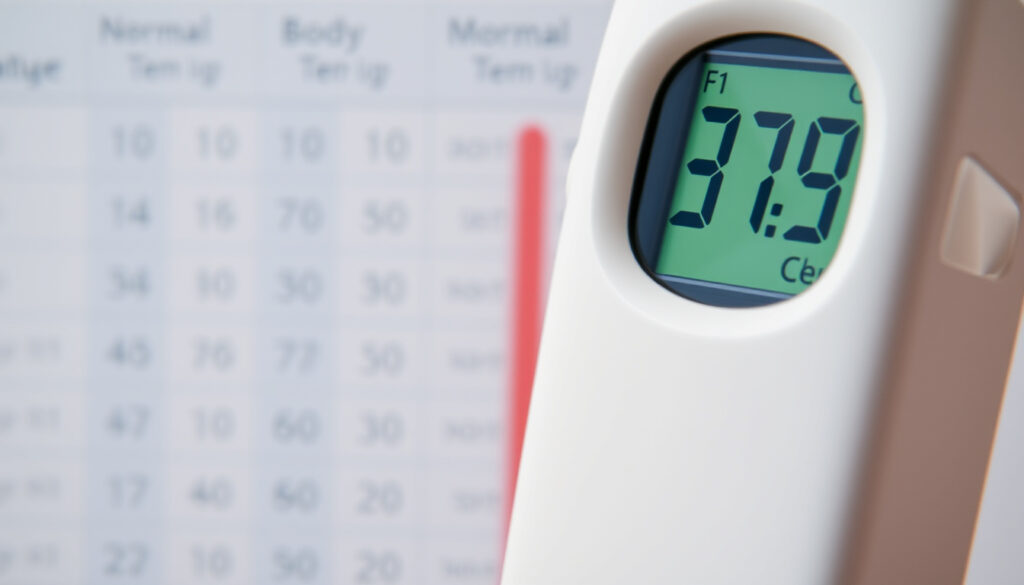
37.9 C to F: Conversion and Normal Body Temperature Guide
You glance at the thermometer and see 37.9°C — not quite the 37.0°C you think of as normal, but also not the 38.0°C that many call a fever. That one-degree gap is actually a clinical gray zone, and understanding it can save you unnecessary worry. We’ll convert 37.9°C to Fahrenheit (100.22°F), compare it against official fever thresholds, and show you when context — time of day, age, measurement method — really matters.
37.9°C in Fahrenheit: 100.22°F ·
Normal adult body temperature range: 36.1°C – 37.2°C (97°F – 99°F) ·
Low-grade fever threshold (adult): 37.2°C – 37.5°C (99°F – 99.5°F) ·
Fever threshold (adult): ≥38.0°C (100.4°F)
Quick snapshot
- 37.9°C equals 100.22°F (CHKD Temperature Conversion Chart)
- Normal adult oral temperature is approximately 37°C (98.6°F) (Harvard Health Publishing)
- Fever in adults is defined as ≥38.0°C (100.4°F) (Mayo Clinic)
- Whether 37.9°C alone indicates illness without other symptoms — many healthy adults reach this in the evening (Harvard Health Publishing)
- Individual normal temperature varies; what’s normal for one person may be elevated for another (Harvard Health Publishing)
- Body temperature peaks in late afternoon and can be 0.5°C higher than morning readings (Mayo Clinic)
- 37.9°C taken at 4 p.m. carries different meaning than the same reading at 7 a.m. (Mayo Clinic)
- Monitor for additional symptoms (chills, aches, cough) — 37.9°C alone is rarely cause for alarm in adults (Harvard Health Publishing)
- Recheck temperature in 1-2 hours, especially if you feel unwell (Harvard Health Publishing)
Six key facts, one takeaway: 37.9°C sits in a clinical middle ground between normal and fever, and the interpretation depends heavily on measurement method and time of day.
The table below shows how different health authorities classify this reading.
| Label | Value |
|---|---|
| 37.9°C in Fahrenheit | 100.22°F (CHKD Temperature Conversion Chart) |
| Normal adult oral temperature | ~37°C (98.6°F) (Harvard Health Publishing) |
| Normal temperature range (adult) | 36.1°C – 37.2°C (97°F – 99°F) (Mayo Clinic) |
| Low-grade fever range | 37.3°C – 38.0°C (99.1°F – 100.4°F) (Harvard Health Publishing) |
| Fever threshold (adult) | ≥38.0°C (100.4°F) (Mayo Clinic; Harvard Health Publishing) |
| Alternative definition (oral fever) | >100°F (37.8°C) — Brown University Health considers oral temp over 100°F a fever (Brown University Health) |
Is 37.9 C considered a fever?
What is the medical definition of fever?
- The Mayo Clinic (leading U.S. medical center) defines a fever in adults as a temperature of 38°C (100.4°F) or higher when measured orally, rectally, in the ear, or on the temporal artery.
- Harvard Health Publishing (Harvard Medical School’s health resource) uses the same 38°C threshold for fever and categorizes temperatures between 37.3°C and 38.0°C as a low-grade fever.
- Australia’s government health service Healthdirect (national health advice service) states that 38°C or higher is “probably a fever.”
So 37.9°C falls just 0.1°C shy of the classic fever cut-off. That’s why it is often called a low-grade fever — elevated, but not formally a fever under most mainstream definitions.
An adult reading 37.9°C is in a gray area: you won’t trigger most clinical fever protocols, but you’re clearly above the average daytime temperature. The same reading in a child under 3 months, however, warrants immediate medical attention because their immune systems are immature.
How does 37.9°C compare to fever thresholds?
- Normal: 36.1°C – 37.2°C (97°F – 99°F) per Mayo Clinic
- Low-grade fever: 37.3°C – 38.0°C (99.1°F – 100.4°F) per Harvard Health Publishing
- Fever: ≥38.0°C (100.4°F) per Mayo Clinic and Harvard Health Publishing
- Alternative definition: Brown University Health (academic medical system) considers any oral temperature over 100°F (37.8°C) a fever, which would include 37.9°C.
The pattern: one major health system says 37.9°C is a fever; two others say it’s not quite there. This isn’t a contradiction — it’s a reflection that fever thresholds are population averages, not absolute cut-offs.
What is 37.9 C in temperature?
How to convert 37.9°C to Fahrenheit
The formula is simple: multiply by 9/5, then add 32.
- Calculation: (37.9 × 9/5) + 32 = (68.22) + 32 = 100.22°F
- This matches the CHKD Temperature Conversion Chart (Children’s Hospital of The King’s Daughters), which lists 37.9°C as 100.2°F.
For quick reference: 38.0°C = 100.4°F, so 37.9°C is just one-tenth of a degree Celsius below the classic fever line in Fahrenheit as well.
What does 37.9°C feel like?
- Many adults report feeling warm, flushed, or slightly achy at this temperature — similar to the sensation before a fever fully develops.
- TYLENOL (Johnson & Johnson consumer health brand) notes that a low-grade fever (99–100.4°F) may not require medication unless accompanied by discomfort.
- If you have no other symptoms, 37.9°C may not feel like anything unusual — especially in the afternoon when body temperature naturally rises.
The trade-off: relying on how you feel is unreliable. Many people with COVID-19 or early flu register 37.8–38.0°C and report only mild warmth, while others with the same reading feel totally normal.
Is 37.9 too hot as body temperature?
What temperature is considered too high?
- Harvard Health Publishing (Harvard Medical School) defines high-grade fever as 39.1°C (102.4°F) or higher.
- Mayo Clinic advises seeking medical attention for a fever of 39.4°C (103°F) or higher in adults.
- 37.9°C is well below these danger thresholds — it’s considered a low-grade elevation, not a high fever.
However, Brown University Health notes that armpit temperature over 99°F (37.2°C) or rectal/ear/forehead over 100.4°F (38°C) are considered fever, showing that measurement site changes the interpretation.
When should you seek medical advice for a temperature of 37.9°C?
- In healthy adults: 37.9°C alone is not an emergency. Monitor for symptoms like difficulty breathing, persistent cough, severe headache, or confusion.
- In infants under 3 months: any temperature of 38°C (100.4°F) or higher requires immediate medical evaluation (Mayo Clinic). 37.9°C is close — seek advice if the child appears ill.
- In older adults or those with chronic conditions: a temperature of 37.9°C that persists for more than 24 hours should be checked by a doctor (Harvard Health Publishing).
Why this matters: the number alone doesn’t tell the full story. The patient’s age, symptoms, and overall health determine whether 37.9°C is a non-event or an early warning sign.
If your 37.9°C reading is accompanied by a stiff neck, rash, or sensitivity to light — even without a high fever — those are red flags that need urgent medical attention regardless of the thermometer.
Confirmed facts
- 37.9°C equals 100.22°F (CHKD)
- Normal body temperature is typically 36.1–37.2°C (Mayo Clinic)
- Fever is generally defined as ≥38.0°C (Harvard Health)
- Low-grade fever range is 37.3–38.0°C (Harvard Health)
What remains unclear
- Whether 37.9°C alone indicates illness without other symptoms — many healthy adults reach this in the evening (Mayo Clinic)
- Exact normal temperature varies by individual and measurement site — an armpit reading of 37.9°C may be less concerning than an oral one (Brown University Health)
“A true fever is defined as a temperature of 100.4°F (38°C) or higher.”
— Mayo Clinic (leading U.S. medical center)
“If you have a temperature of 38°C or higher, you probably have a fever.”
For a healthy adult reading 37.9°C, the implication is clear: you’re in a low-grade zone that warrants monitoring but rarely panic. Check your temperature again in a few hours, pay attention to how you feel overall, and remember that a single thermometer reading is just one data point — not a diagnosis.
Related reading: **20 cm to Inches** · **23 cm to Inches**
Modern clinical data shows that average body temperature has shifted slightly, making it important to understand normal body temperature ranges when evaluating a reading of 37.9°C.
Frequently asked questions
What is 37.9°C in Fahrenheit?
37.9°C equals 100.22°F. The conversion formula is (°C × 9/5) + 32. This is a low-grade temperature elevation, just below the standard fever threshold of 38°C (100.4°F). (CHKD Temperature Conversion Chart)
Is 37.9°C a fever for adults?
Under most medical guidelines, 37.9°C is not considered a true fever — that starts at 38.0°C (100.4°F). However, some sources like Brown University Health classify oral temperatures over 37.8°C as fever. It is generally classified as a low-grade fever. (Mayo Clinic; Brown University Health)
Is 37.9°C a fever for children?
In children, fever is also generally defined as 38°C or higher. But for infants under 3 months, any temperature of 38°C (100.4°F) or higher requires immediate medical attention. 37.9°C is very close — if your baby appears unwell, contact a doctor. (Mayo Clinic)
Should I go to the doctor if my temperature is 37.9°C?
For a healthy adult with no other symptoms, 37.9°C alone does not require a doctor’s visit. If you have additional symptoms like severe headache, difficulty breathing, rash, or confusion, seek medical advice. For older adults or those with chronic conditions, contact your doctor if the temperature persists. (Harvard Health Publishing)
Can 37.9°C be normal in the evening?
Yes. Body temperature naturally rises throughout the day, peaking in the late afternoon or early evening. A temperature of 37.9°C at 6 p.m. could be within normal variation for some individuals, especially if you’ve been active. (Mayo Clinic)
How do I convert Celsius to Fahrenheit?
Use the formula: °F = (°C × 9/5) + 32. For example, 37.9°C × 9/5 = 68.22, plus 32 = 100.22°F. For quick estimation, double the Celsius and add 30. (CHKD Temperature Conversion Chart)
What does a low-grade fever mean?
A low-grade fever (37.3–38.0°C) often indicates your immune system is responding to a mild infection, such as a cold or early viral illness. It can also be caused by exercise, hormonal changes, or overheating. Most low-grade fevers resolve on their own without treatment. (Harvard Health Publishing)
More related posts
 Hall of Fame Game 2026: Date, Time, Teams, How to Watch
 What time is it in Arizona? Current local time guide
 We Live, We Love, We Lie: Lyrics, Meaning & Meme Explained
 Smiling Friends Season 3: Release Date, Finale & Where to Watch
 iPhone 16 Pro Max Ireland: Price, Specs & Should You Buy in 2025
 Smokey and the Bandit Cast: Roles, Ages, Who’s Still Alive
 When Does Implantation Bleeding Occur? Timing & Signs
 Tennessee Titans vs Cleveland Browns Match Player Stats