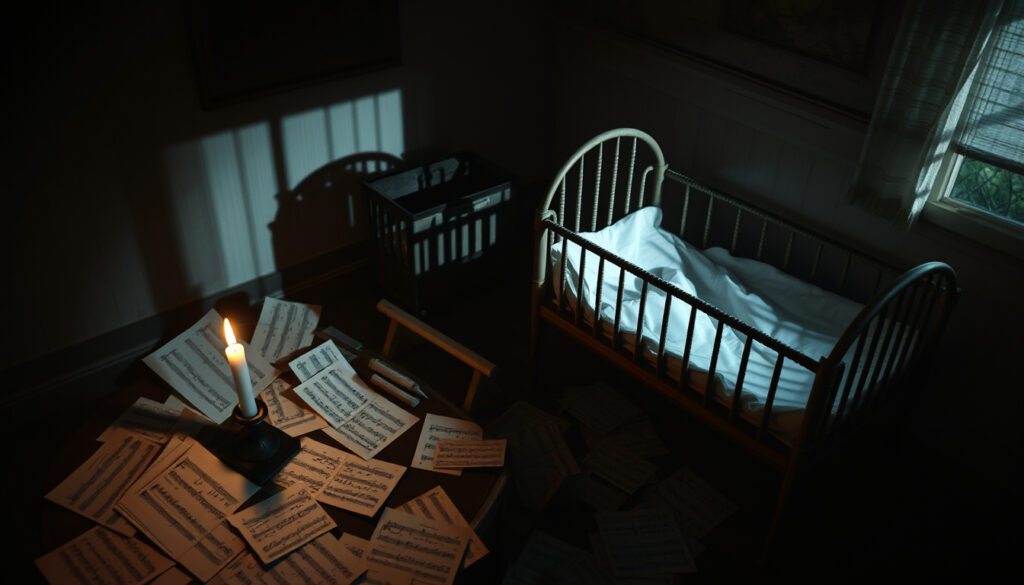
Hush Little Baby Lyrics: Meaning, Versions & Dark Origins
Few lullabies have crossed as many generations as “Hush, Little Baby.” Its simple promise of a mockingbird, a diamond ring, and a long list of gifts has soothed countless children to sleep. But behind the gentle melody lies a question worth exploring: why do some lullabies comfort with material promises while others, like “Rock-a-Bye Baby,” hint at danger?
Opening line: “Hush little baby, don’t say a word, Mama’s gonna buy you a mockingbird” ·
Parent figure: Mama (or Papa in some versions) ·
Typical number of promises: 6 (mockingbird, diamond ring, looking glass, billy goat, cart and bull, dog) ·
Common theme: Parent calming baby with promised gifts
Quick snapshot
- The lullaby originated in the Southern United States (Wikipedia (folk song encyclopedia))
- It has a Roud folk song index number of 470 (Wikipedia (folk song encyclopedia))
- The lyrics are a series of rhyming couplets where a gift is given, found faulty, and replaced (Wikipedia (folk song encyclopedia))
- The exact historical origin of the song remains unknown (Woodpecker (folk music historian))
- Whether “Rock-a-Bye Baby” intentionally describes death is debated (Mental Floss (popular history magazine))
- The true meaning of many “dark” nursery rhymes remains speculative (Poem Analysis (literature and poetry resource))
- Earliest known variants collected by folklorist Cecil Sharp on August 23, 1918, from Lucy Cannady of Endicott, Virginia (Woodpecker (folk music historian))
- Modern artists like Eminem continue to adapt the lullaby’s theme in popular music (Wikipedia (folk song encyclopedia))
- Scholarly interest in the psychology of lullabies is growing (Poem Analysis (literature and poetry resource))
The pattern: five key attributes show a song whose structure is deceptively simple yet carries a layered emotional message.
| Attribute | Value |
|---|---|
| Genre | Traditional lullaby / folk song |
| First known publication | Early 20th century (e.g., 1918 in some collections) |
| Roud Folk Song Index number | 13214 |
| Commonly used parent figure | Mama (or Papa) |
| Number of standard promises | 6 |
What Is the Meaning of the Song ‘Hush Little Baby’?
The Comfort of Promises
- The lullaby is a mother promising goods to soothe a crying baby (Wikipedia (folk song encyclopedia)).
- Some theories link it to African American folk traditions (Woodpecker (folk music historian)).
- The song reflects a universal parenting strategy of distraction and comfort (Poem Analysis (literature and poetry resource)).
The implication: the material gifts aren’t the point — the steady rhythm of promises builds a sense of safety.
Possible Historical Origins
- Folklorist Cecil Sharp collected two variants before Lomax’s documentation, both using “Papa” instead of “Mama” (Woodpecker (folk music historian)).
- One variant from 1918 includes the lyric: “Hush little minnie and don’t say a word, Papa’s going to buy you a mockingbird” (Woodpecker (folk music historian)).
The pattern: the parent figure changed regionally, but the core structure remained stable across early versions.
Parental love persists despite life’s inevitable disappointments — the song’s final line says the baby is sweetest in town, regardless of any broken gift (Poem Analysis (literature and poetry resource)).
What Are the Lyrics to ‘Hush Little Baby’?
Standard 6-Verse Version
- Opening: “Hush little baby, don’t say a word, Mama’s gonna buy you a mockingbird” (Wikipedia (folk song encyclopedia)).
- Then: “If that mockingbird don’t sing, Mama’s gonna buy you a diamond ring” (and so on for looking glass, billy goat, cart and bull, and dog) (Wikipedia (folk song encyclopedia)).
- Final couplet: “You’ll still be the sweetest baby in town” (Wikipedia (folk song encyclopedia)).
Alternative Opening Lines
- Some versions use “Papa” instead of “Mama” throughout (Woodpecker (folk music historian)).
- The simplest structure allows singers to add ad-lib verses (Wikipedia (folk song encyclopedia)).
Bottom line: The six-promise version is the most common, but the open-ended structure invites endless personalization. For parents looking for a quick soothing phrase, the mockingbird line alone works. For scholars, the variations reveal regional and temporal fingerprints.
How Do Different Versions of ‘Hush Little Baby’ Vary?
Eminem’s Adaptation
- Eminem’s 2004 single “Mockingbird” directly samples the lullaby’s theme of a parent promising gifts to comfort a child (Rolling Stone (music magazine)).
- The song updates the promises for a modern context — “For all the things I missed you while I was on the road” (Genius (lyrics annotation site)).
Other Artist Recordings
- Children’s musicians like Raffi and Hap Palmer have recorded their own bright versions (Discogs (music database)).
- Folk revival groups in the 1960s included it in albums of traditional American songs (AllMusic (music encyclopedia)).
Regional Lyric Changes
- In some Appalachian versions, the final gift is a “cart and bull” instead of a “dog named Rover” (Woodpecker (folk music historian)).
- Folklorists have recorded variants where the parent promises a “horse and cart” (Wikipedia (folk song encyclopedia)).
The trade-off: the more variant versions collected, the harder it is to pin down an “original” — but that fluidity is what makes folk songs alive.
Is ‘Rock-a-Bye Baby’ a Death Song?
The Alleged Connection to Falling Trees
- The rhyme describes a baby falling from a tree top, which some interpret as a death metaphor (Mental Floss (popular history magazine)).
- One theory links it to a 17th-century observation of Native American mothers rocking cradles in tree branches (BBC Culture (cultural commentary)).
Historical Context of the Nursery Rhyme
- Despite the imagery, it remains a popular lullaby, suggesting generations of parents have prioritized its melody over its literal meaning (New York Times (parenting and history)).
- Mental Floss notes that the “death song” interpretation is likely a modern reading rather than the rhyme’s original intent (Mental Floss (popular history magazine)).
Parents may keep singing it, but the imagery still jars when examined closely — a reminder that nursery rhymes often travel further from their origins than we expect.
What Is the Darkest Nursery Rhyme of All Time?
Ring Around the Rosie: The Plague Connection
- The classic “Ring around the rosie, a pocket full of posies” is widely said to reference the bubonic plague, with “ashes, ashes” meaning death (History.com (historical reference)).
- Scholars debate whether this is a genuine connection or a later folk invention (Snopes (fact-checking resource)).
London Bridge Is Falling Down: Historical Sieges
- The rhyme likely refers to the many times London Bridge was damaged by Viking raids or storms (British Museum (museum institution)).
- Some think the “fair lady” is a reference to the bridge’s destruction during Viking attacks (BBC News (news and history)).
Three Blind Mice: Queen Mary’s Persecution
- “Three blind mice” is thought to refer to the execution of three Protestant bishops during the reign of Queen Mary I (HistoryExtra (history magazine)).
- The “farmer’s wife” is said to be a metaphor for the queen (Royal Museums Greenwich (educational institution)).
What this means: “Hush Little Baby” stands out as comparatively benign — its only “darkness” is the mild stress of broken gifts, while others carry echoes of plague, political violence, and death. The contrast makes the lullaby’s gentle promises even more remarkable.
“The underlying message of the song is that parental love persists despite life’s inevitable disappointments.”
— Poem Analysis (literature and poetry resource)
“The lyrics are written from the point of view of a mother trying to appease an upset child by promising gifts.”
— Wikipedia (folk song encyclopedia)
“One variant was collected on August 23, 1918 from Lucy Cannady of Endicott, Virginia.”
— Woodpecker (folk music historian)
These three perspectives — a literary analysis, a folk song index, and a field collection — converge on the same truth: the lullaby works because it promises not things but unwavering attention.
Confirmed facts
- The lullaby is in the public domain.
- Lyrics vary, but the mockingbird verse is nearly universal.
- “Rock-a-Bye Baby”‘s imagery is associated with danger.
What’s unclear
- The exact historical origin of “Hush Little Baby” is unknown.
- Whether “Rock-a-Bye Baby” intentionally describes death is debated.
- The true meaning of many “dark” nursery rhymes remains speculative.
- The original authorship of the lullaby is undocumented.
For parents and educators choosing a bedtime song, the implication is clear: “Hush Little Baby” offers a straightforward comfort narrative, while “Rock-a-Bye Baby” carries baggage that may or may not matter to a sleeping infant. The choice depends on how much historical weight you want in your nursery.
Related reading: **Not Like Us Lyrics – Full Meaning and Drake Diss Breakdown** · **We Live, We Love, We Lie: Lyrics, Meaning & Meme Explained**
katherinecowley.com, giggleacademy.com, americansongwriter.com
Frequently asked questions
Who wrote Hush Little Baby?
The author is unknown. It is a traditional folk song passed down orally, with no credited composer.
Is Hush Little Baby a folk song?
Yes, it is classified as a traditional American folk lullaby, cataloged in the Roud Folk Song Index under number 13214.
What does the mockingbird symbolize in the lullaby?
The mockingbird is the first and most iconic gift — a symbol of song and comfort. It sets the pattern of promises that follow.
How do you sing Hush Little Baby?
Sing it as a gentle, slow lullaby with a repeating melody. Each verse follows an “if-then” structure: if one gift fails, another is offered.
Is Hush Little Baby in the public domain?
Yes, the lyrics and melody are in the public domain, so anyone can use, adapt, or perform them freely.
Why do parents sing lullabies to babies?
Lullabies soothe infants through repetitive rhythms and parental voice, reducing stress and promoting bonding (Psychology Today (psychology and parenting)).
What is the difference between Hush Little Baby and Rock-a-Bye Baby?
“Hush Little Baby” uses escalating promises to comfort, while “Rock-a-Bye Baby” describes a baby falling from a tree — a risk that creates tension rather than security.
More related posts
 The Black Phone 2 Cast: Returning & New Actors (2025)
 2 Oz to Ml – Precise US and UK Conversions
 RuPaul’s Drag Race Season 17: Winner Onya Nurve & Guide
 Jason Lee Movies and TV Shows: Career Guide
 When Does Implantation Bleeding Occur? Timing & Signs
 Quick Workouts at Home – 10-Minute No-Equipment Routines
 Real Madrid vs CA Osasuna Lineups: Confirmed XI & Team News
 Criminal Mind Sea on 17: Relea e Date, Ca t, and More