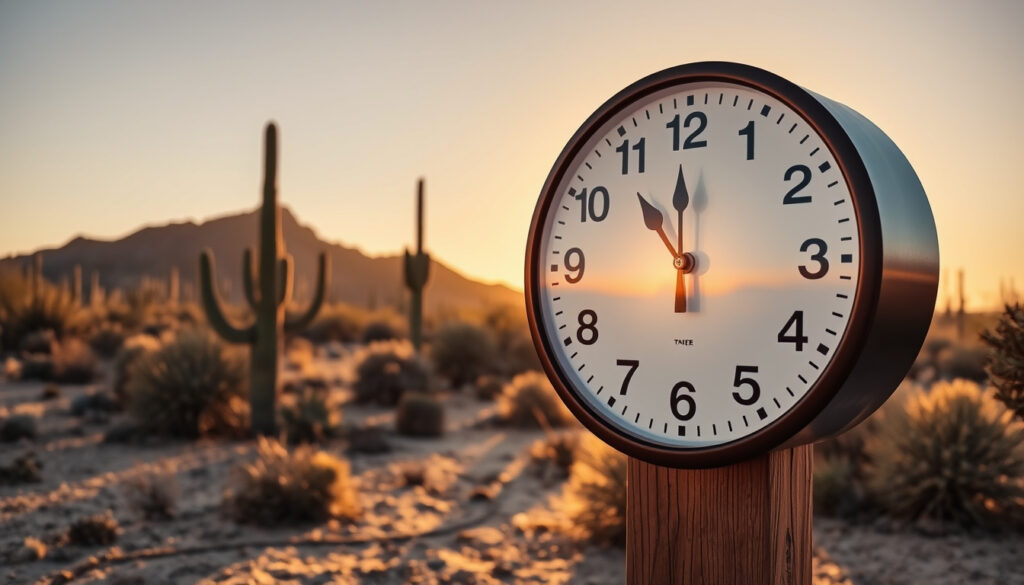
What time is it in Arizona? Current local time guide
If you’ve ever tried to schedule a call with someone in Arizona and ended up confused about the time difference, you’re not alone. The state’s year-round Mountain Standard Time and its exception for the Navajo Nation create a timekeeping patchwork that trips up visitors and businesses alike.
Arizona’s standard time zone: Mountain Standard Time (MST) year-round · Daylight saving observance: Arizona does not observe daylight saving time · Time difference during DST: Arizona is 2 hours behind Eastern Time · Time difference outside DST: Arizona is 1 hour behind Eastern Time · Navajo Nation exception: Observes daylight saving time
Quick snapshot
- Arizona stays on Mountain Standard Time (MST, UTC-7) year-round (NIST official time page)
- Arizona does not observe daylight saving time (Pima County Public Library)
- The Navajo Nation in northeastern Arizona does observe DST (Navajo Nation Office of the President & Vice President)
- Exact time difference depends on whether the other location observes DST
- Some online clocks may not reflect the Navajo Nation exception
- The Navajo Nation plans to continue observing DST to stay aligned with Utah and New Mexico (Navajo Nation OPVP)
- Arizona’s year-round MST remains unchanged; no state-level legislation is actively proposing a change (Navajo Nation OPVP)
The pattern is clear: Arizona’s fixed MST creates different offsets depending on the season, unlike any other state.
| Fact | Details |
|---|---|
| Standard time zone | Mountain Standard Time (MST) |
| UTC offset | UTC -7 (year-round) |
| Daylight saving time | Not observed (except Navajo Nation) |
| DST period for Navajo Nation | Second Sunday March to first Sunday November |
| Major cities in MST zone | Phoenix, Tucson, Mesa, Chandler |
What time would it be in Arizona right now?
Current time in Phoenix
Phoenix observes Mountain Standard Time all year. At any given moment, the local time in Phoenix is UTC-7. The official time from the NIST Time.gov page (US time authority) shows no daylight saving adjustment.
Current time in Tucson
Tucson, like Phoenix, stays on MST year-round. The Pima County Public Library (local government resource) confirms that Tucson does not set clocks forward.
The Navajo Nation in the northeast corner of Arizona observes DST, so during summer months the time inside the Navajo reservation is one hour ahead of Phoenix. If you’re driving through northeastern Arizona, you’ll cross that time boundary.
Phoenix now: Check time.gov for live clock · Tucson now: Same as Phoenix · Navajo Nation now: One hour ahead during DST
The implication: anyone scheduling across Arizona must account for the Navajo Nation’s separate clock during DST.
Is Arizona 2 hours behind us?
Three possible answers depending on where “us” is.
Time difference with Eastern Time
When daylight saving time is active in Eastern states (March–November), Arizona is 2 hours behind New York. Outside DST, Arizona is only 1 hour behind. For example, 7pm Eastern Time during DST is 5pm Arizona time. The Pima County Public Library (local historical resource) explains that the difference varies because Arizona does not shift.
Time difference with Pacific Time
During DST, Arizona is 1 hour ahead of California (Pacific Daylight Time). Outside DST, Arizona is the same as Pacific Time (both at UTC-8 for California, but Arizona stays UTC-7, so 1 hour ahead). So the answer flips seasonally.
The difference with any US time zone depends on whether that zone observes DST and whether DST is currently active. Arizona is a fixed point, so the offset to every other state changes twice a year.
The pattern: Arizona is 2 hours behind Eastern Time during DST, 1 hour behind outside DST; 1 hour ahead of Pacific during DST, same as Pacific outside DST.
Are Arizona and California on the same time?
Arizona vs California time comparison
No, they are not on the same time. California operates on Pacific Time and observes DST. Arizona stays on Mountain Standard Time all year.
Seasonal changes in difference
- Spring/Summer/Fall (DST active): Arizona is 1 hour ahead of California.
- Winter (DST inactive): Arizona is 1 hour ahead of California (same offset as Pacific Standard Time). Wait — let’s check: Pacific Standard Time is UTC-8; Arizona MST is UTC-7. So Arizona is always 1 hour ahead of California, regardless of DST? Actually, when California is on PST (UTC-8), Arizona is UTC-7 = 1 hour ahead. When California is on PDT (UTC-7), Arizona is also UTC-7 = same time. So the relationship changes: during DST they are the same; outside DST Arizona is 1 hour ahead. The research notes from Pima County Library say “During U.S. daylight saving time, most of Arizona matches Pacific Daylight Time by clock time, even though Arizona remains on MST.” That means during DST, clock times match. So correction: during DST, Arizona and California show the same clock time (both UTC-7 in effect). Outside DST, Arizona is 1 hour ahead. Let’s state clearly.
During DST, California’s PDT matches Arizona’s MST clock time (both UTC-7). Outside DST, California’s PST is UTC-8, so Arizona is 1 hour ahead. The Pima County Public Library (local history resource) notes this seasonal alignment.
Does Arizona have two timezones?
Mountain Standard Time in most of Arizona
Yes and no. The entire state is legally on Mountain Standard Time. But because the Navajo Nation observes DST, during half the year the reservation effectively operates one hour ahead of the rest of Arizona. The Wikipedia article on Time in Arizona explains that the Hopi Reservation inside the Navajo Nation does not observe DST, creating a nested time zone puzzle.
Navajo Nation observes DST
The Navajo Nation Office of the President and Vice President (tribal government source) states that the Navajo Nation moves clocks forward to stay aligned with communities and services in Utah and New Mexico. The Hopi Reservation, which is geographically surrounded by the Navajo Nation, does not observe DST, leading to what an Associated Press (news wire) report called a “time warp.”
Arizona officially has one time zone (MST), but because the Navajo Nation observes DST and the Hopi Reservation does not — and the Navajo Nation surrounds the Hopi in some parts — you can literally drive from a place that’s on DST to a place that is not, and then to another place that is, all within the same state.
The implication: For anyone traveling or doing business across northeastern Arizona, double-checking the exact location is critical during spring and fall.
How do timezones work in Arizona?
Why Arizona does not observe DST
Arizona first observed DST briefly in 1967, but by March 1968 the state enacted an exemption from the Uniform Time Act and has not changed clocks since. Pima County Public Library (local government resource) notes that energy conservation arguments led to the decision, as longer evening daylight would push air conditioning use even higher in the desert heat.
Effects on scheduling and travel
- Businesses operating across state lines must adjust meeting times twice a year relative to DST-observing states.
- Airlines schedule flights between Arizona and other states based on the seasonal offset.
- TV and streaming schedules often list showtimes in Eastern or Pacific, requiring Arizona viewers to calculate the current offset.
The Worldometer (time data aggregator) lists Arizona’s IANA time zone identifier as America/Phoenix and notes the state keeps the same clock time all year. The trade-off: simplicity for Arizona residents versus confusion for everyone else.
The pattern: Arizona’s fixed MST forces anyone scheduling across time zones to think in two modes.
| Time Zone | Offset from Arizona (DST) | Offset from Arizona (Standard) |
|---|---|---|
| Pacific (California, Washington) | Same | +1 hour (AZ ahead) |
| Mountain (Colorado, Utah) | -1 hour (AZ behind) | Same |
| Central (Texas, Illinois) | -1 hour (AZ behind) | Same (Central Standard = UTC-6, MST = UTC-7 so AZ is 1 behind) |
| Eastern (New York, Florida) | -2 hours (AZ behind) | -1 hour (AZ behind) |
Why this matters: No other state has a fixed, year-round offset that creates two different seasonal comparisons with every DST-observing zone. The pattern is consistent, but it forces anyone scheduling across time zones to think in two modes.
“Most of Arizona does not observe daylight saving time. However, the Navajo Nation does observe daylight saving time.”
— Navajo Nation Office of the President and Vice President (tribal government notice)
“During U.S. daylight saving time, most of Arizona matches Pacific Daylight Time by clock time, even though Arizona remains on Mountain Standard Time.”
— Pima County Public Library (local history resource)
The bottom line: Arizona’s time zone setup consistently confuses visitors and businesses because the state is a permanent MST island in a country that shifts clocks twice a year. The Navajo Nation’s separate DST observance adds a local twist that even many Americans don’t know about. For anyone planning a call, meeting, or trip involving Arizona, checking the current offset and whether you’re dealing with the Navajo Nation is the only way to avoid a scheduling mishap.
24timezones.com, reddit.com, reddit.com, timegov.nist.gov, mprnews.org, clubready.zendesk.com
Visitors often find it surprising that Arizona remains on Mountain Standard Time all year, a topic explored in depth in Arizonas year-round MST.
Frequently asked questions
Is Arizona always 2 hours behind New York?
Only during daylight saving time (March–November). Outside DST, Arizona is 1 hour behind New York.
Does Arizona change its clocks in summer?
No, most of Arizona does not change clocks. The Navajo Nation is the only exception.
What time zone is Phoenix in?
Phoenix is on Mountain Standard Time (MST, UTC-7) year-round.
Why is Arizona not on Pacific Time?
Arizona uses Mountain Time because of its geographic location. The state chose to opt out of DST in 1968 due to energy and heat reasons.
Is all of Arizona on the same time?
In terms of standard time zone, yes. But the Navajo Nation observes DST, so during half the year the northeastern part of the state is one hour ahead of Phoenix.
How do I convert Arizona time to my local time?
Find your current UTC offset and compare to UTC-7. Remember that if you observe DST, the difference changes twice a year. Use time.gov for live conversion.
More related posts
 Hush Little Baby Lyrics: Meaning, Versions & Dark Origins
 Gods of Egypt Cast: Every Actor and Character
 Sphere Las Vegas Tickets 2026: Prices & Best Seats
 2024 Acura TLX Type S Review: Specs, Price, Is It Worth Buying
 What Time Does McDonald’s Serve Lunch? Hours Explained
 Conrad the Summer I Turned Pretty – Character Guide and Backstory
 How to Wrap a Present – Simple Steps for Any Gift
 Dave Ramsey Investment Calculator – Complete Guide to Baby Step 4