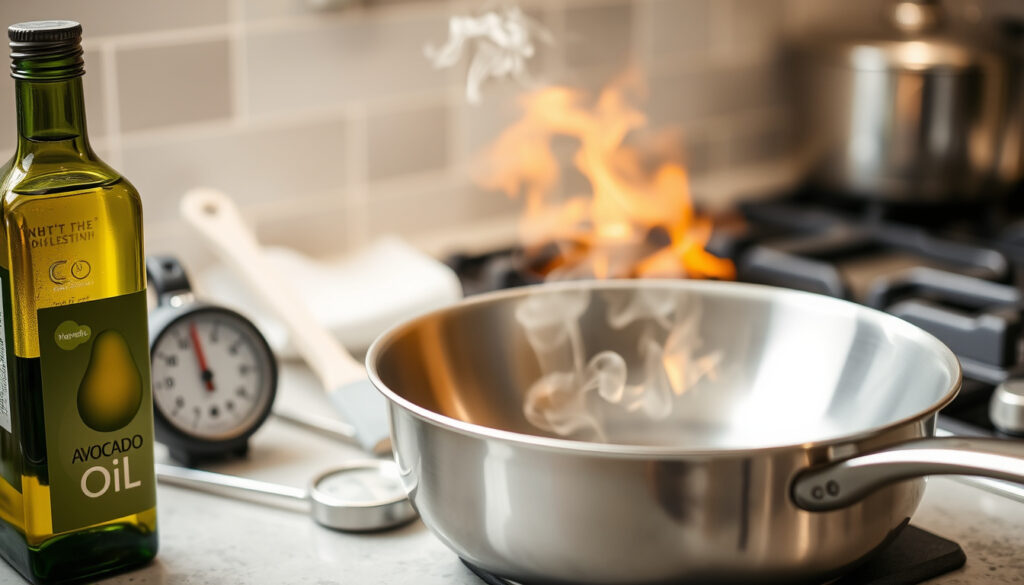
Avocado Oil Smoke Point: Guide for High Heat Cooking
If you’ve ever watched a pan of oil start smoking and wondered whether it’s time to toss it, you’re not alone, because avocado oil’s reality depends heavily on whether you buy refined or unrefined. Here’s a fact-checked look at what those smoke-point numbers actually mean for your frying pan and your health.
Smoke point of refined avocado oil: 500°F (260°C) ·
Smoke point of extra virgin avocado oil: 482°F (250°C) ·
Avocado oil rank among high-smoke-point oils: Highest common cooking oil ·
Monounsaturated fat content: ~70%
Quick snapshot
- Refined avocado oil smoke point: 500°F (260°C) (Soilmates (cooking oil guide))
- Extra virgin (unrefined) smoke point: 482°F (250°C) (Soilmates) (Soilmates (cooking oil guide))
- High in heart-healthy monounsaturated fats (~70%) (American Heart Association (heart health authority))
- Exact smoke point of some cold-pressed avocado oils varies by producer (vomFASS USA (specialty oil retailer))
- Long-term health effects of repeatedly heating avocado oil past its smoke point are not fully studied (vomFASS USA (specialty oil retailer))
- 2020s: Avocado oil surges in popularity as a high-heat cooking oil (industry trend) (UC Davis (university food science research))
- 2023: UC Davis study finds many avocado oil brands adulterated with cheaper oils (UC Davis (university food science research))
- 2025: Growing demand for cold-pressed, unrefined options (market observation) (UC Davis (university food science research))
- Expect more transparency in smoke-point labeling as consumers demand precision
- Unrefined avocado oil offerings will increase, widening the price gap between grades
Five key facts that define avocado oil’s place in your kitchen.
| Fact | Value |
|---|---|
| Smoke point (refined) | 500°F (260°C) |
| Smoke point (extra virgin) | 482°F (250°C) |
| Fat composition | ~70% monounsaturated, 15% polyunsaturated, 15% saturated |
| Vitamin E per tbsp | ~2.1 mg (14% DV) |
| Common uses | Frying, sautéing, baking, salad dressings |
Is avocado oil ok for high heat cooking?
Yes — provided you choose the right grade. Refined avocado oil has a smoke point of 500°F (260°C) according to Soilmates (cooking oil resource), which places it well above the typical frying range of 350–450°F. Chosen Foods (avocado oil producer) states that their oil can be used for baking, sautéing, and pan-frying without burning. The WebstaurantStore (foodservice equipment guide) advises that oils with smoke points over 450°F are safest for frying, stir-frying, and broiling – avocado oil qualifies comfortably.
Home cooks who frequently sear meat or stir-fry can rely on refined avocado oil without worrying about smoke filling the kitchen. The extra virgin (unrefined) version, at 482°F (250°C) per Zero Acre, is still excellent for most high-heat tasks, but its flavor is stronger and may not suit every dish.
The implication: for everyday high-heat cooking, refined avocado oil is the most reliable choice.
What is the smoke point of avocado oil?
- Refined: 500°F (260°C) – Soilmates and vomFASS USA both confirm this range
- Extra virgin/unrefined: 482°F (250°C) – Soilmates; La Tourangelle (oil producer) lists a lower 375°F for standard avocado oil, illustrating that brand-specific variation exists
- Some producers, like La Tourangelle, distinguish “avocado oil” (375°F) from “extra virgin avocado oil” (325°F), suggesting that not all unrefined oils are equal
The implication: always check the label. “Refined” or “extra virgin” matters more than the brand name.
How does refined vs unrefined affect smoke point?
Refining removes free fatty acids and impurities, which raises the smoke point. La Tourangelle explicitly states that refined oils generally have a higher smoke point and are more suited to high-heat cooking like deep-frying and searing. The trade-off: refining can strip some of the natural antioxidants and flavor compounds. For everyday frying, refined is the safer bet; for cold applications like dressings, unrefined preserves more of the oil’s character.
Which is better olive oil or avocado oil?
Both are rich in monounsaturated fats and considered heart-healthy by the American Heart Association (cardiovascular health authority). The key difference is heat tolerance.
Smoke point comparison
Three dimensions, one pattern: avocado oil wins for heat, olive oil wins for antioxidant content.
| Criterion | Avocado Oil | Olive Oil |
|---|---|---|
| Smoke point (refined) | 500°F (260°C) | 465°F (241°C) for extra light olive oil |
| Smoke point (extra virgin) | 482°F (250°C) | 375°F (191°C) |
| Antioxidant content | Moderate; contains vitamin E | High; rich in polyphenols |
| Flavor | Neutral to buttery | Fruity, peppery (EVOO) |
| Best for | Frying, searing, baking | Dressings, dips, low-heat cooking |
Health benefits comparison
The catch: “extra virgin” labels are not strictly regulated for avocado oil as they are for olive oil. A 2023 UC Davis study (university food science research) found that many avocado oil brands were adulterated with cheaper oils. For health + heat flexibility, choose a trusted brand with third-party testing.
Flavor and uses
Avocado oil’s neutral flavor makes it versatile for both savory and sweet dishes, while olive oil’s distinctive taste shines in cold preparations.
What oil is the highest smoke point?
Refined avocado oil consistently tops the common-cooking-oil chart. WebstaurantStore’s guide lists avocado oil at 510–520°F, calling it the highest smoke point among plant-based cooking oils. vomFASS USA’s 2026 chart places refined avocado oil at 480–520°F (249–271°C).
Top high smoke point oils: avocado, ghee, canola
Here’s how the leading candidates stack up (data from multiple sources including Zero Acre and Wikipedia (reference data)):
- Refined avocado oil: 500°F (260°C) — highest common oil
- Ghee (clarified butter): 485°F (252°C)
- Refined peanut oil: 450°F (232°C)
- Refined sunflower oil: 440°F (227°C)
- Canola oil: 400°F (204°C)
Smoke point chart
Eight oils, one takeaway: avocado oil is the undisputed champion for high heat.
| Oil | Smoke Point (°F) | Smoke Point (°C) |
|---|---|---|
| Refined avocado oil | 500 | 260 |
| Ghee | 485 | 252 |
| Refined peanut oil | 450 | 232 |
| Refined sunflower oil | 440 | 227 |
| Canola oil | 400 | 204 |
| Extra virgin olive oil | 375 | 191 |
| Coconut oil (virgin) | 350 | 177 |
| Butter | 300 | 149 |
The pattern: refined avocado oil stands alone at the top, offering a 15°F margin over ghee and a 50°F margin over peanut oil. For anyone who regularly deep-fries or sears, that buffer means less oxidation and fewer smoke alarms.
Is there a downside to avocado oil?
Yes, and it’s not just the price. While avocado oil is undeniably healthy and versatile, three issues deserve attention: cost, purity, and processing trade-offs.
Potential downsides: cost, purity, environmental impact
- Cost. High-quality avocado oil (especially extra virgin cold-pressed) can cost two to three times more than olive oil or canola.
- Purity. The UC Davis study (2023) tested 22 avocado oil products and found that over 80% were rancid before expiration or adulterated with cheaper oils like sunflower or soybean oil.
- Processing. Refining removes some of the natural vitamin E and antioxidants. Chosen Foods notes that once an oil reaches its smoke point, it breaks down and becomes oxidized, which may cause damage to cells and increase health risks – though they caution that the evidence is not yet conclusive.
How to choose quality avocado oil
- Look for third-party testing (e.g., Certified Pure or lab-verified claims).
- Prefer brands that state “refined” or “extra virgin” clearly on the label.
- Check the production date – avocado oil has a shelf life of 12–18 months.
- Avoid bottles stored in clear glass near heat sources. Dark glass or opaque packaging protects against oxidation.
Refined avocado oil gives you the highest smoke point but sacrifices some of the natural nutrients. Unrefined oil preserves more flavor and antioxidants but has a lower smoke point and costs more. For most home cooks, a refined bottle for frying and an extra virgin bottle for dressings is the pragmatic split.
The pattern: balancing smoke point and nutrient preservation requires owning two grades.
What is the healthiest oil to cook with?
“Healthiest” depends on how you cook. The American Heart Association recommends oils with primarily unsaturated fats – avocado, olive, canola, and sunflower. Avocado oil excels because its high smoke point allows you to use it for high-heat methods without creating harmful compounds.
Criteria for a healthy cooking oil
- High in unsaturated fats (monounsaturated and polyunsaturated).
- Low in saturated and trans fats.
- Stable at your cooking temperature – i.e., smoke point well above your typical heat.
- Minimally processed when possible (cold-pressed retains antioxidants).
Top healthy oils: avocado, olive, coconut
- Avocado oil (~70% monounsaturated) – great for frying, searing, and baking.
- Olive oil (~73% monounsaturated, rich in polyphenols) – best for low-heat cooking and raw use.
- Coconut oil (~90% saturated) – stable at mid heat but high in saturated fat; use occasionally.
Oils to avoid
- Partially hydrogenated oils (trans fats).
- Highly refined seed oils (soybean, corn, cottonseed) when used repeatedly at high heat – they can form trans fats.
- Blended “vegetable oil” with no specification of source – often a mix of cheap, highly processed seeds.
The pattern: avocado oil is the most versatile, but olive oil is the richer source of antioxidants. The healthiest approach is to match the oil to the temperature.
Upsides
- Highest smoke point among common cooking oils (WebstaurantStore)
- Rich in monounsaturated fats, heart-healthy per AHA
- Neutral flavor, works for both savory and sweet cooking
- Contains vitamin E (14% DV per tbsp)
Downsides
- Expensive compared to olive oil or canola
- Adulteration is widespread – UC Davis study found 80%+ of samples compromised
- Refining removes some natural antioxidants and flavor
- Environmental footprint of importing avocados for oil is higher than locally pressed oils
What readers say – quotes from experts and brands
“Avocado oil can be used for baking, sautéing, and pan frying without burning.”
“Replace saturated fats with unsaturated fats – such as avocado oil – to help protect your heart.”
— American Heart Association (heart health authority)
“Oils with smoke points of 480°F or higher have a high smoke point.”
For American home cooks who prioritize both health and cooking performance, the choice is clear: keep a bottle of refined avocado oil for frying and searing, and reserve extra virgin olive oil for cold dishes. The alternative – using a lower-smoke-point oil for high heat – will degrade the oil, create off-flavors, and potentially introduce harmful compounds.
Related reading: Is Vitamin Water Good for You? · Libby’s Pumpkin Pie Recipe
Frequently asked questions
What is the smoke point of avocado oil in Celsius?
Refined avocado oil: 260°C; extra virgin (unrefined): 250°C (Soilmates).
Can avocado oil be used for deep frying?
Yes. Refined avocado oil at 500°F (260°C) is well above the typical deep-frying range of 350–375°F, making it one of the safest options (WebstaurantStore).
Is avocado oil better than ghee for high heat?
Avocado oil has a slightly higher smoke point (500°F vs. 485°F for ghee). Both are excellent, but avocado oil is plant‑based and cholesterol‑free, while ghee adds a buttery flavor.
Does avocado oil go bad?
Yes. Avocado oil oxidizes over time. Store it in a cool, dark place and use within 12–18 months of the production date. Rancid oil has a pungent, crayon‑like smell.
How can I tell if my avocado oil is high quality?
Look for a dark glass bottle, a clear “refined” or “extra virgin” label, a production date, and third‑party purity certification. Avoid bottles with no provenance information.
Is unrefined avocado oil the same as extra virgin?
In most cases, yes. Soilmates defines extra virgin avocado oil as unrefined or cold‑pressed. However, unlike olive oil, the term “extra virgin” is not legally regulated for avocado oil, so quality varies.
What is the best avocado oil brand for high heat cooking?
Chosen Foods and Primal Kitchen are widely available and offer refined avocado oil with documented smoke points. Always check independent test results if available.
More related posts
 Galaxy A33 to Buy: Price, Specs, and Is It Worth It in 2026
 Son Ye‑jin Biography: Marriage to Hyun Bin, Baby & Career
 Poison Ivy Rash Stages – Timeline Symptoms and Treatment
 Cheesy Pick Up Lines: 111 Funny Rizz for Him & Her
 How to Use ChatGPT Effectively: Top Tips for 2025
 How Long Can a Human Go Without Eating? Facts & Timeline
 One Battle After Another: Where to Watch in Ireland, UK & US
 The Incredible Hulk Cast: 2008 Film Actors and History